Procedure 14-12: Operate/release loopbacks
 Overview
 |
NOTICE Service-disruption hazard |
Performing this procedure may affect service. This procedure may be used to create a facility, terminal, or cross-connect (tributary) loopback at the specified interface.
This procedure should only be used during pre-service testing of facilities and during fault diagnostics. The facility and terminal loopback requests remain active until released; for example, by command, or until overridden by an NE initialization or repowering. The cross-connect loopback request remains active until released by command or overridden by an NE database restoration.
Use this procedure to operate or release Facility, Terminal, or Cross-Connect loopbacks on the specified interface on the VLNC50/52/55 circuit pack. (Facility loopbacks are not supported on the OC-N/STM-N ports of the VLNC50/52/55 circuit pack.)
The VLNC61/62 circuit packs support terminal and facility loopbacks on DS1 and E1 interfaces. The VLNC64 circuit pack supports terminal and facility loopbacks on SONET/SDH interfaces. The VLNC35 circuit pack supports terminal loopbacks on Fast Ethernet LAN ports.
For loopback information on the VLNC6x and VLNC35 circuit packs, refer to the loopback {facility | terminal | loopback-eth | loopback-opt} command in the Alcatel-Lucent 1850 Transport Service Switch (TSS-5) Command Line Interface Guide.
Important!
This procedure uses the WaveStar® CIT Fault → Analysis → Port Loopback command or the TL1 opr-lpbk/rls-lpbk commands to operate or release loopbacks on the VLNC50/52/55 circuit packs.
Operate or release TL1 loopback commands are denied if inband- or FEAC-requested loopbacks are enabled. Similarly, inband- or FEAC-requested loopbacks cannot be enabled if a TL1 opr-lpbk request is active.
In-band-requested loopbacks
For loopbacks operated or released using inband loopback requests on the VLNC50/52/55 circuit packs, refer to the inbandlpbkfiber and inbandlpbkdsx parameters of the TL1 ent-t1 command in the Alcatel-Lucent 1850 Transport Service Switch (TSS-5) TL1 Command Guide for MSPP.
-
When inbandlpbkdsx is enabled, the NE will put up a facility loopback when it sees a DS1 signal coming from the DSX containing the signal pattern 11000 for at least 5 seconds, or if it sees an ESF-formatted signal with a BOC code of “0 001001 0 11111111” four times contiguously. The NE releases the DSX-requested loopback when it sees a DS1 signal coming from the DSX containing the signal pattern “11100” for at least five seconds, or if it sees an ESF-formatted signal with a BOC code of “0 010010 0 11111111” or “0 011100 0 11111111” four times contiguously.
-
When inbandlpbkfiber is enabled, the NE will put up a terminal loopback when it sees one of the following activation signals and no loopback request from the fiber is active. If it sees one of the activation signals while a terminal loopback is already active, then it puts up a facility loopback in addition to the terminal loopback. The activation signals are a DS1 signal coming from the fiber containing the signal pattern “11000” for at least five seconds, or an ESF-formatted signal with a BOC code of “0 001001 0 11111111” four times contiguously. The NE releases any active fiber-requested loopback(s) when it sees a DS1 signal coming from the fiber containing the signal pattern “11100” for at least five seconds, or if it sees an ESF-formatted signal with a BOC code of “0 010010 0 11111111” or “0 011100 0 11111111” four times contiguously.
For inband loopback requests from the DSX for the VLNC6x circuit packs, refer to the inbandlpbkdsx command in the Alcatel-Lucent 1850 Transport Service Switch (TSS-5) Command Line Interface Guide. When enabled, the NE will set up a facility loopback when it sees a T1 signal coming from the DSX containing the signal pattern 11000 for at least 5 seconds, or if it sees an ESF-formatted signal with a BOC code of 0 001001 0 11111111 4 times contiguously. The NE releases the DSX-requested loopback when it sees a T1 signal coming from the DSX containing the signal pattern 11100 for at least 5 seconds, or if it sees an ESF-formatted signal with a BOC code of 0 010010 0 11111111 or 0 011100 0 11111111 four times contiguously.
FEAC-requested loopbacks
The VLNC50/52/55 circuit packs support Far End Alarm and Control (FEAC) requested DS1 and DS3 facility loopbacks on the channelized, C-bit framed, b-3 DS3 port. The FEAC-requested loopbacks are provisioned using FEAC codes within the b-3 DS3 signal received from the DSX. Requests may be accepted for the DS3 line, individual constituent DS1 signals, or all constituent DS1 signals simultaneously.
The ability to respond to FEAC loopback requests is provisionable on the b-3 DS3 port only, and is by default disabled. If FEAC-requested loopbacks are enabled, then WaveStar® CIT-based facility loopbacks (VLNC50/52/55) are denied. Terminal loopbacks are not denied. If FEAC-requested loopbacks are disabled while a FEAC-requested loopback is active, the loopback is released.
Privilege level
You must log in as either a Privileged or General user to complete this procedure.
Facility loopbacks
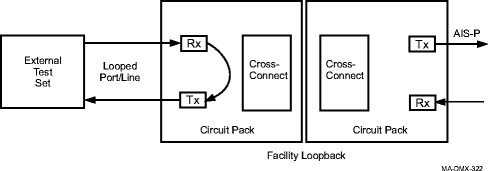
A Facility loopback connects the incoming received signal to the transmitter in the return direction. Electrical signals are looped back intact, including BPVs. Optical signals are looped back after the optical to electrical conversion.
The VLNC50/52/55 circuit pack supports facility loopbacks on DS1/E1 and DS3/E3 interfaces only. Facility loopbacks are not supported on OC-N/STM-N interfaces.
The following figure shows a facility loopback used in a test arrangement with an external test set.
Figure 14-10: Facility loopback example
Path or line switching requests are generated in UPSR/SNCP applications.
Terminal loopbacks
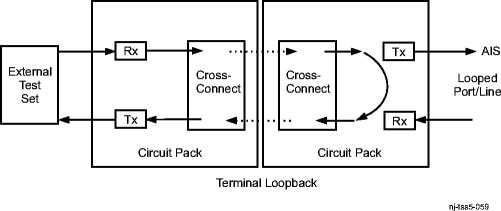
A Terminal loopback connects the entire signal that is about to be transmitted back into the associated incoming receiver.
The VLNC50/52/55 circuit pack supports terminal loopbacks on DS1, E1, DS3, and E3 interfaces only.
The following figure shows a terminal loopback used in a test arrangement with an external test set.
Figure 14-11: Terminal loopback example
Cross-connect (tributary) loopbacks
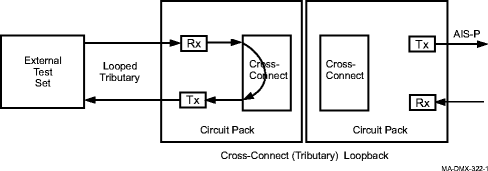
A Cross-Connect loopback connects the incoming received tributary to the outgoing transmitted tributary in the return direction.
Cross-connect loopbacks can be provisioned using the WaveStar® CIT Fault → Analysis → Cross-Connect Loopback command.
Unconnected tributaries on an OC-N/STM-N interface may be looped back at any rate for which a cross-connection would be allowed for that tributary. For example, in SONET shelves, m1-1-1 may be looped back at the STS1 rate, or at the STS3c rate if tributaries 2 and 3 are also unconnected. Any unconnected VT1.5 may be looped back.
Connected tributaries on an OC-N/STM-N interface may be looped back at the connected rate, if the loopback Command Mode is set to Forced (default is NORM) as a part of the loopback request. AIS is always inserted in the egress direction of the cross-connection. The AIS may or may not be seen, depending on whether the line/path is currently active.
If a cross-connection exists before the loopback is created, the cross-connection is restored once the loopback is released. Any number of tributaries can have a cross-connect loopback at the same time.
The VLNC50/52/55 circuit pack supports cross-connect loopbacks on any tributary (STSn/VT1.5/VCn).
The following figure shows a cross-connect loopback used in a test arrangement with an external test set.
Figure 14-12: Cross-connect (tributary) loopback example
Before you begin
Prior to performing this procedure:
-
Refer to Before you begin and Required equipment in this chapter.
-
Refer to Laser safety and Electrostatic discharge in Chapter 1, Safety.
-
Obtain the work instructions for this procedure and verify that the port AID is specified.
Steps
Use this procedure to operate or release a facility, terminal, or cross-connect loopback.
1 |
Result: The Loopback window opens. | |||||||
2 |
Find and expand the details for the required groups. Select (highlight) the required port/tributary, then click Select at the bottom of the window. Result: The loopback parameters appears. | |||||||
3 |
Select Operate or Release. If required, select the Loopback Type (Terminal or Facility). | |||||||
4 |
Click Apply to perform the selected operation. Result: A warning appears asking you to confirm executing this command. Click Yes and Close. End of steps |