
SR-TE LSP Path Computation Using Local CSPF
This chapter describes the SR-TE LSP path computation using local CSPF.
Topics in this chapter include:
Applicability
This chapter was initially written for SR OS Release 19.10.R1, but the CLI in the current edition corresponds to SR OS Release 25.10.R2. Local CSPF can be used in IPv4 SR-TE LSP primary and secondary path computation in SR OS Release 19.7.R1, and later.
Overview
Segment Routing with Traffic Engineering Label Switched Paths (SR-TE LSPs) can be computed using:
hop-to-label (IP-to-label) translation (default; no path-computation-method)
Path Computation Element (PCE) path computation (path-computation-method pce)
local Constrained Shortest Path First (CSPF) (path-computation-method local-cspf)
Hop-to-label path computation
SR-TE LSP path computation uses hop-to-label translation as the default computation method. The PCC interrogates the TE database, and translates any hop configured in the applied path statement to a Node SID (N-SID) or Adjacency SID (A-SID), to produce a list of segment IDs. Strict hops are mapped to adjacency SIDs; loose hops are mapped to node SIDs. The destination address in the LSP configuration implies a final loose hop.
PCE path computation
SR-TE LSP path computation can also be performed using an external PCE controller. In this case, the PCC maintains a Path Computation Element Protocol (PCEP) session with the PCE and the path computation is done as follows:
the PCC sends a PCReq requesting a path
the PCE replies with a PCReply including a path (if available). This path contains a segment list.
Optionally, the PCC sends a path status report (PCRpt) to the PCE. However, the PCC may also delegate the control of the path to the PCE.
PCE path computation is supported for SR-TE LSPs, but not for SR-TE LSP templates. You cannot have PCE path computation for SR-TE LSPs that use LSP templates one-hop-p2p-srte or mesh-p2p-srte auto-LSPs. PCE path computation is not further treated in this chapter.
Local CSPF path computation
SR-TE LSP path computation using local CSPF can be used in single-area OSPFv2 or single-level IS-IS IGP instances. More complex LSP path computations, or when the network is expanded into multiple IGP areas or instances, require an external PCE.
One of the major changes to the SR-TE algorithm from RSVP-TE CSPF is that SR-TE does not require each router to be TE enabled: the links do not have to be TE links. Provided that the routers at each end of the link are SR enabled, local CSPF calculates an end-to-end path.
Full CSPF path computation on the head-end router (PCC) results in a full explicit path to the destination. The PCC calculates an end-to-end path and the following applies:
The computed path is a full explicit TE path.
Each link is represented by an adjacency SID or adjacency set SID.
CSPF returns a label stack list of adjacency SIDs or adjacency set SIDs.
Like RSVP-TE LSPs, an SR-TE LSP can be resignaled when a timer expires or when an operator issues a tools command.
Paths computed by local CSPF contain an adjacency SID for each link in the path and the stack may contain numerous labels. If the max-sr-labels value may be exceeded or the maximum segment depth of a downstream router may be less than the calculated LSP label stack size, the label stack can be reduced. The label reduction capability can replace a series of adjacency SIDs with a node SID. For loose-hop path computation, node SIDs can be used or a combination of node and adjacency SIDs.
Local CSPF is supported on both primary and secondary standby paths of an SR-TE LSP. Local CSPF path calculation can be used for RSVP-TE LSP as well as for SR-TE LSP templates.
Local CSPF path computation and SR protected interfaces
When SR is enabled and IGP adjacency is established over a link, the router advertises an adjacency SID in the adjacency SID sub-TLV. When Loop-Free Alternate (LFA), Remote LFA (RLFA), or Topology-Independent LFA (TI-LFA) is enabled, protected adjacencies have the backup flag (B-flag) set in the adjacency SID sub-TLV. Each adjacency is available for SID protection when LFA, RLFA, or TI-LFA is enabled. It is possible to remove the SID protection on a specific link (no sid-protection).
Adjacency sets are specified in an adjacency-set sub-TLV as a single object. Adjacency sets never have the B-flag set and are always unprotected. However, each individual link in the adjacency set is protected. For more information about adjacency sets, see the Parallel Adjacency Sets in Segment Routing chapter.
Local CSPF path calculation can set up a path that:
only includes protected adjacencies (local-sr-protection mandatory)
only includes unprotected adjacencies (local-sr-protection none)
can include both protected and unprotected adjacencies (local-sr-protection preferred/no local-sr-protection (default))
Configuration
Example topology shows the example topology.
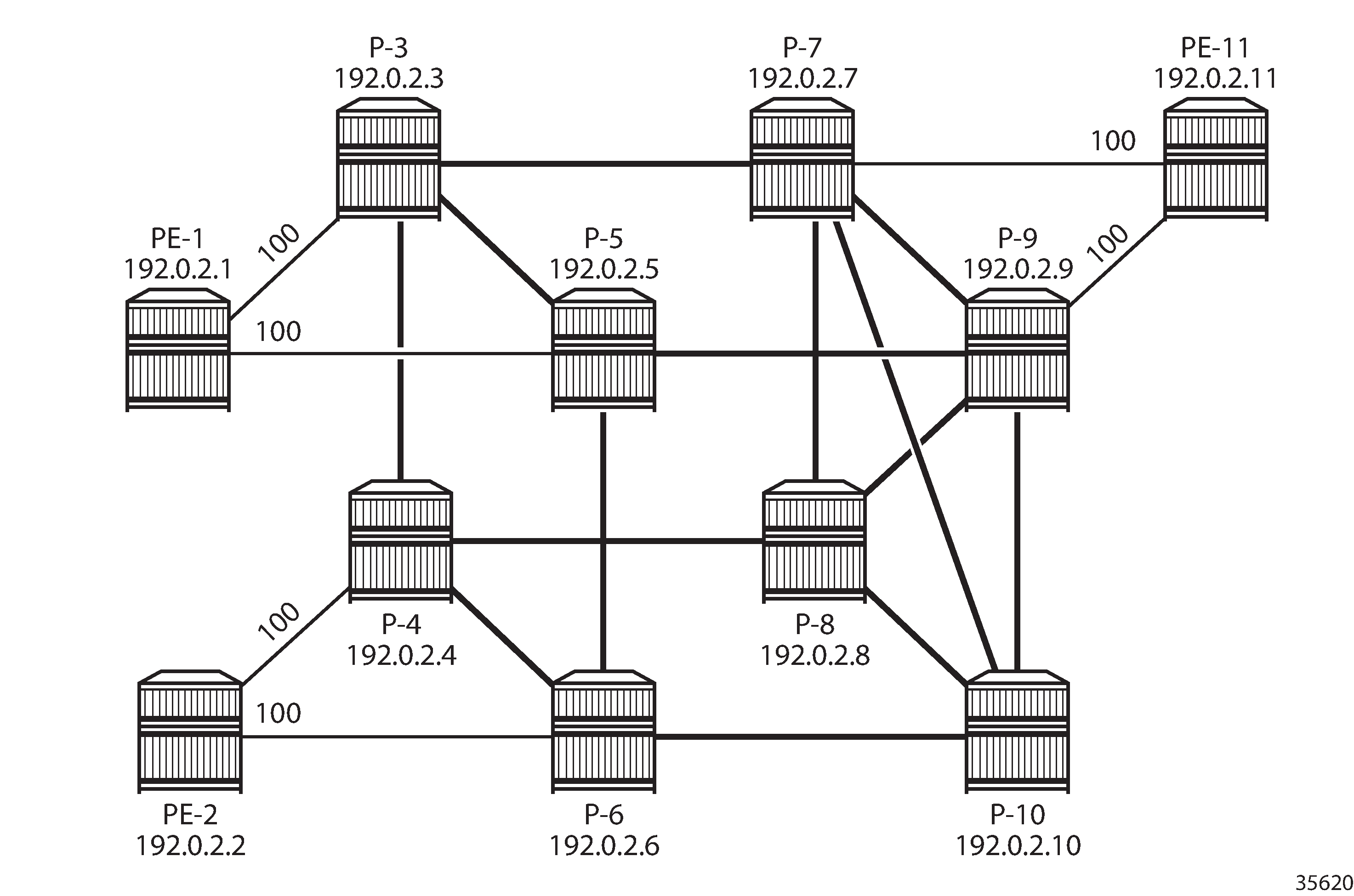
The initial configuration on each of the nodes includes:
Cards, MDAs, ports
Router interfaces
IS-IS enabled on all router interfaces (alternatively, OSPFv2 can be used as IGP)
The interfaces in the core (between P-3, P-4, P-5, P-6, P-7, P-8, P-9, and P-10) have metric 10.
The access interfaces to and from PE-1, PE-2, and PE-11 have metric 100.
TE is enabled on the head-end routers.
MPLS is enabled on the head-end routers.
For an in-depth description of the configuration of SR-ISIS, see the Segment Routing with IS-IS Control Plane chapter. On PE-2, the IS-IS configuration is as follows:
# on PE-2:
configure
    router Base
        mpls-labels
            sr-labels start 32000 end 32999
        exit
        isis 0
            level-capability level-2            # single-level IS-IS instance
            area-id 49.0001
            traffic-engineering                # TE enabled on head-end routers
            advertise-router-capability area
            level 2
                wide-metrics-only
            exit
            segment-routing
                prefix-sid-range global
                no shutdown
            exit
            interface "system"
                ipv4-node-sid index 2
                no shutdown
            exit
            interface "int-PE-2-P-4"
                interface-type point-to-point
                level 2
                    metric 100                    # metric 100 on access interfaces
                exit
                no shutdown
            exit
            interface "int-PE-2-P-6"
                interface-type point-to-point
                level 2
                    metric 100                    # metric 100 on access interfaces
                exit
                no shutdown
            exit
            no shutdown
        exit
With this configuration, the node SID on PE-2 is 32000 + index 2 = 32002. The configuration is similar on the other nodes.
On PE-2, the following SR-TE LSPs are configured toward PE-11:
SR-TE LSP with empty path and:
hop-to-label path computation
local CSPF path computation without label stack reduction
local CSPF path computation with label stack reduction
SR-TE LSP with path with two strict hops—P-4 and P-3—and:
hop-to-label path computation
local CSPF path computation without label stack reduction
local CSPF path computation with label stack reduction
SR-TE LSP with path with two loose hops—P-3 and P-9—and:
hop-to-label path computation
local CSPF path computation without label stack reduction
local CSPF path computation with label stack reduction
SR-TE LSPs using empty path
The configuration of SR-TE LSPs is described in chapter Segment Routing – Traffic Engineered Tunnels. On PE-2, the following SR-TE LSPs toward PE-11 are configured with an empty path. The path computation method is hop-to-label for the first SR-TE LSP and local CSPF for the second SR-TE LSP.
# on PE-2:
configure
    router Base
        mpls
            path "empty-path"
                no shutdown
            exit
            lsp "LSP-PE-2-PE-11_empty-path_hop-to-label" sr-te
                to 192.0.2.11
                no path-computation-method      # default
                metric-type igp                 # default
                max-sr-labels 6 additional-frr-labels 2
                primary "empty-path"
                exit
                no shutdown
            exit
            lsp "LSP-PE-2-PE-11_empty-path_localCSPF" sr-te
                to 192.0.2.11
                path-computation-method local-cspf
                metric-type igp                 # default
                max-sr-labels 6 additional-frr-labels 2
                primary "empty-path"
                exit
                no shutdown
            exit
With hop-to-label path computation, the destination 192.0.2.11 is an implied loose hop that is mapped to the node SID 32011 of the destination PE-11, as follows:
*A:PE-2# show router mpls sr-te-lsp "LSP-PE-2-PE-11_empty-path_hop-to-label" path detail

===============================================================================
MPLS SR-TE LSP LSP-PE-2-PE-11_empty-path_hop-to-label
Path  (Detail)
===============================================================================
Legend :
    S      - Strict                      L      - Loose
    A-SID  - Adjacency SID               N-SID  - Node SID
    +      - Inherited
===============================================================================
-------------------------------------------------------------------------------
LSP SR-TE LSP-PE-2-PE-11_empty-path_hop-to-label
Path  empty-path
-------------------------------------------------------------------------------
LSP Name    : LSP-PE-2-PE-11_empty-path_hop-to-label
Path LSP ID      : 20992
From             : 192.0.2.2
To               : 192.0.2.11
Admin State      : Up                      Oper State        : Up
Path Name   : empty-path
Path Type        : Primary
Path Admin       : Up                      Path Oper         : Up
Path Up Time     : 0d 01:07:31             Path Down Time    : 0d 00:00:00
Retry Limit      : 0                       Retry Timer       : 30 sec
Retry Attempt    : 0                       Next Retry In     : 0 sec

PathCompMethod   : none                    OperPathCompMethod: none
MetricType       : igp                     Oper MetricType   : igp
LocalSrProt      : preferred               Oper LocalSrProt  : N/A
LabelStackRed    : Disabled                Oper LabelStackRed: N/A

Bandwidth        : No Reservation          Oper Bandwidth    : 0 Mbps
Hop Limit        : 255                     Oper HopLimit     : 255
Setup Priority   : 7                       Oper SetupPriority: 7
Hold Priority    : 0                       Oper HoldPriority : 0
DelayMetricLimit : No limit                OperDelayMetricLim: N/A
Inter-area       : N/A

PCE Updt ID      : 0                       PCE Updt State    : None
PCE Upd Fail Code: noError

PCE Report       : Disabled+               Oper PCE Report   : Disabled
PCE Control      : Disabled                Oper PCE Control  : Disabled

Include Groups   :                         Oper IncludeGroups:
None                                           None
Exclude Groups   :                         Oper ExcludeGroups:
None                                           None
Last Resignal    : n/a

IGP/TE/Del Metric: 16777215                Oper Metric       : 16777215
Oper MTU         : 8978                    Path Trans        : 1
Degraded         : False
Failure Code     : noError
Failure Node     : n/a
Explicit Hops    :
    No Hops Specified
Actual Hops      :
    192.0.2.11(192.0.2.11)(N-SID)                Record Label        : 32011

BFD Configuration and State
Template         : None                    Ping Interval     : N/A
Enable           : False                   State             : notApplicable
ReturnPathLabel  : None
BFD Source Addr  : None
WaitForUpTimer   : 4 sec                   OperWaitForUpTimer: 0 sec
WaitForUpTmLeft  : 0
StartFail Rsn    : N/A

===============================================================================
With local CSPF path computation, the SR-TE path contains contiguous strict hops with A-SIDs. Several ECMP paths are available and, in this case, the path goes from PE-2 via P-4, P-3, and P-7 to the destination PE-11, as follows:
*A:PE-2# show router mpls sr-te-lsp "LSP-PE-2-PE-11_empty-path_localCSPF" path detail

===============================================================================
MPLS SR-TE LSP LSP-PE-2-PE-11_empty-path_localCSPF
Path  (Detail)
===============================================================================
Legend :
    S      - Strict                      L      - Loose
    A-SID  - Adjacency SID               N-SID  - Node SID
    +      - Inherited
===============================================================================
-------------------------------------------------------------------------------
LSP SR-TE LSP-PE-2-PE-11_empty-path_localCSPF
Path  empty-path
-------------------------------------------------------------------------------
LSP Name    : LSP-PE-2-PE-11_empty-path_localCSPF
Path LSP ID      : 52736
From             : 192.0.2.2
To               : 192.0.2.11
Admin State      : Up                      Oper State        : Up
Path Name   : empty-path
Path Type        : Primary
Path Admin       : Up                      Path Oper         : Up
Path Up Time     : 0d 01:07:31             Path Down Time    : 0d 00:00:00
Retry Limit      : 0                       Retry Timer       : 30 sec
Retry Attempt    : 0                       Next Retry In     : 0 sec

PathCompMethod   : local-cspf              OperPathCompMethod: local-cspf
MetricType       : igp                     Oper MetricType   : igp
LocalSrProt      : preferred               Oper LocalSrProt  : preferred
LabelStackRed    : Disabled                Oper LabelStackRed: Disabled

---snip---

IGP/TE/Del Metric: 220                     Oper Metric       : 220
Oper MTU         : 8966                    Path Trans        : 1
Degraded         : False
Failure Code     : noError
Failure Node     : n/a
Explicit Hops    :
    No Hops Specified
Actual Hops      :
    192.168.24.2(192.0.2.4)(A-SID)               Record Label        : 524287
 -> 192.168.34.1(192.0.2.3)(A-SID)               Record Label        : 524286
 -> 192.168.37.2(192.0.2.7)(A-SID)               Record Label        : 524284
 -> 192.168.117.2(192.0.2.11)(A-SID)             Record Label        : 524283

---snip---
The path goes from PE-2 via P-4, P-3, and P-7 to the destination PE-11, as shown in Empty path from PE-2 to PE-11.

By enabling label stack reduction, the label stack of Adjacency SIDs (A-SIDs) can be reduced to a smaller number of Node SIDs (N-SIDs), or a combination of N-SIDs and A-SIDs, while still honoring TE constraints.
If the user enables label stack reduction for an SR-TE LSP, a second CSPF phase is applied, attempting to reduce the label stack that resulted from the fully explicit path with adjacency SIDs and adjacency sets SIDs computed in CSPF phase 1. The procedure of the label stack reduction algorithm is described in the 7750 SR and 7950 XRS Segment Routing and PCE User Guide.
The following SR TE LSP is configured with label-stack-reduction:
# on PE-2:
configure
    router Base
        mpls
            lsp "LSP-PE-2-PE-11_empty-path_localCSPF_red" sr-te
                to 192.0.2.11
                path-computation-method local-cspf
                label-stack-reduction
                max-sr-labels 6 additional-frr-labels 2
                primary "empty-path"
                exit
                no shutdown
            exit
In this example, the label stack is reduced to the N-SID of the destination PE-11, as follows:
*A:PE-2# show router mpls sr-te-lsp "LSP-PE-2-PE-11_empty-path_localCSPF_red" path detail

---snip---
-------------------------------------------------------------------------------
LSP SR-TE LSP-PE-2-PE-11_empty-path_localCSPF_red
Path  empty-path
-------------------------------------------------------------------------------
---snip---

PathCompMethod   : local-cspf              OperPathCompMethod: local-cspf
MetricType       : igp                     Oper MetricType   : igp
LocalSrProt      : preferred               Oper LocalSrProt  : preferred
LabelStackRed    : Enabled                 Oper LabelStackRed: Enabled

---snip---

IGP/TE/Del Metric: 220                     Oper Metric       : 220
Oper MTU         : 8978                    Path Trans        : 1
Degraded         : False
Failure Code     : noError
Failure Node     : n/a
Explicit Hops    :
    No Hops Specified
Actual Hops      :
    192.0.2.11(192.0.2.11)(N-SID)                Record Label        : 32011

---snip---
SR-TE LSPs using path with strict hops
In the following example, the SR-TE LSP path includes strict hops (P-4 and P-3)—that must be contiguous hops from the headend router—and an implicit loose hop to the destination 192.0.2.11. The SR-TE LSPs on PE-2 are configured as follows:
# on PE-2:
configure
    router Base
        mpls
            path "path-via-P-4-P-3_S"
                hop 10 192.0.2.4 strict
                hop 20 192.0.2.3 strict
                no shutdown
            exit
            lsp "LSP-PE-2-PE-11_w-strict-hops_hop-to-label" sr-te
                to 192.0.2.11
                max-sr-labels 6 additional-frr-labels 2
                primary "path-via-P-4-P-3_S"
                exit
                no shutdown
            exit
            lsp "LSP-PE-2-PE-11_w-strict-hops_localCSPF" sr-te
                to 192.0.2.11
                path-computation-method local-cspf
                max-sr-labels 6 additional-frr-labels 2
                primary "path-via-P-4-P-3_S"
                exit
                no shutdown
            exit
With hop-to-label path computation, strict hops are translated into adjacency SIDs, whereas loose hops are translated into node SIDs. In this example, the path has an A-SID to P-4 and an A-SID to P-3 followed by an N-SID to the destination PE-11, as follows:
*A:PE-2# show router mpls sr-te-lsp "LSP-PE-2-PE-11_w-strict-hops_hop-to-label" path detail

===============================================================================
MPLS SR-TE LSP LSP-PE-2-PE-11_w-strict-hops_hop-to-label
Path  (Detail)
===============================================================================
Legend :
    S      - Strict                      L      - Loose
    A-SID  - Adjacency SID               N-SID  - Node SID
    +      - Inherited
===============================================================================
-------------------------------------------------------------------------------
LSP SR-TE LSP-PE-2-PE-11_w-strict-hops_hop-to-label
Path  path-via-P-4-P-3_S
-------------------------------------------------------------------------------
LSP Name    : LSP-PE-2-PE-11_w-strict-hops_hop-to-label
Path LSP ID      : 13312
From             : 192.0.2.2
To               : 192.0.2.11
Admin State      : Up                      Oper State        : Up
Path Name   : path-via-P-4-P-3_S
Path Type        : Primary
Path Admin       : Up                      Path Oper         : Up
Path Up Time     : 0d 01:08:10             Path Down Time    : 0d 00:00:00
Retry Limit      : 0                       Retry Timer       : 30 sec
Retry Attempt    : 0                       Next Retry In     : 0 sec

PathCompMethod   : none                    OperPathCompMethod: none
MetricType       : igp                     Oper MetricType   : igp
LocalSrProt      : preferred               Oper LocalSrProt  : N/A
LabelStackRed    : Disabled                Oper LabelStackRed: N/A
---snip---

IGP/TE/Del Metric: 16777215                Oper Metric       : 16777215
Oper MTU         : 8970                    Path Trans        : 1
Degraded         : False
Failure Code     : noError
Failure Node     : n/a
Explicit Hops    :
                  192.0.2.4(S)
               -> 192.0.2.3(S)
Actual Hops      :
    192.168.24.2(192.0.2.4)(A-SID)               Record Label        : 524287
 -> 192.168.34.1(192.0.2.3)(A-SID)               Record Label        : 524286
 -> 192.0.2.11(192.0.2.11)(N-SID)                Record Label        : 32011

---snip---
With local CSPF path computation, the path is a sequence of A-SIDs, as follows:
*A:PE-2# show router mpls sr-te-lsp "LSP-PE-2-PE-11_w-strict-hops_localCSPF" path detail

===============================================================================
MPLS SR-TE LSP LSP-PE-2-PE-11_w-strict-hops_localCSPF
Path  (Detail)
===============================================================================
Legend :
    S      - Strict                      L      - Loose
    A-SID  - Adjacency SID               N-SID  - Node SID
    +      - Inherited
===============================================================================
-------------------------------------------------------------------------------
LSP SR-TE LSP-PE-2-PE-11_w-strict-hops_localCSPF
Path  path-via-P-4-P-3_S
-------------------------------------------------------------------------------
LSP Name    : LSP-PE-2-PE-11_w-strict-hops_localCSPF
Path LSP ID      : 1024
From             : 192.0.2.2
To               : 192.0.2.11
Admin State      : Up                      Oper State        : Up
Path Name   : path-via-P-4-P-3_S
Path Type        : Primary
Path Admin       : Up                      Path Oper         : Up
Path Up Time     : 0d 01:08:10             Path Down Time    : 0d 00:00:00
Retry Limit      : 0                       Retry Timer       : 30 sec
Retry Attempt    : 0                       Next Retry In     : 0 sec

PathCompMethod   : local-cspf              OperPathCompMethod: local-cspf
MetricType       : igp                     Oper MetricType   : igp
LocalSrProt      : preferred               Oper LocalSrProt  : preferred
LabelStackRed    : Disabled                Oper LabelStackRed: Disabled

---snip---

IGP/TE/Del Metric: 220                     Oper Metric       : 220
Oper MTU         : 8966                    Path Trans        : 1
Degraded         : False
Failure Code     : noError
Failure Node     : n/a
Explicit Hops    :
                  192.0.2.4(S)
               -> 192.0.2.3(S)
Actual Hops      :
    192.168.24.2(192.0.2.4)(A-SID)               Record Label        : 524287
 -> 192.168.34.1(192.0.2.3)(A-SID)               Record Label        : 524286
 -> 192.168.37.2(192.0.2.7)(A-SID)               Record Label        : 524284
 -> 192.168.117.2(192.0.2.11)(A-SID)             Record Label        : 524283

---snip---
The path from PE-2 to PE-11 must go via P-4 and P-3. The loose hop from P-3 to the destination PE-11 is translated into an A-SID to P-7 followed by an A-SID to PE-11, as shown in Path from PE-2 to PE-11 via strict hops P-4 and P-3.
With label stack reduction, the configuration of the SR-TE LSP is as follows:
# on PE-2:
configure
    router Base
        mpls
            lsp "LSP-PE-2-PE-11_w-strict-hops_localCSPF_red" sr-te
                to 192.0.2.11
                path-computation-method local-cspf
                label-stack-reduction
                max-sr-labels 6 additional-frr-labels 2
                primary "path-via-P-4-P-3_S"
                exit
                no shutdown
            exit
Label stack reduction reduces the label stack to one or more node SIDs in segments, with each segment delimited by configured path hops. The computed path to the node SID must satisfy any required path constraints. The calculated path from PE-2 to PE-11 via the strict hops P-4 and P-3 shows a series of N-SIDs, as follows:
*A:PE-2# show router mpls sr-te-lsp "LSP-PE-2-PE-11_w-strict-hops_localCSPF_red" path detail

===============================================================================
MPLS SR-TE LSP LSP-PE-2-PE-11_w-strict-hops_localCSPF_red
Path  (Detail)
===============================================================================
Legend :
    S      - Strict                      L      - Loose
    A-SID  - Adjacency SID               N-SID  - Node SID
    +      - Inherited
===============================================================================
---snip---

PathCompMethod   : local-cspf              OperPathCompMethod: local-cspf
MetricType       : igp                     Oper MetricType   : igp
LocalSrProt      : preferred               Oper LocalSrProt  : preferred
LabelStackRed    : Enabled                 Oper LabelStackRed: Enabled

---snip---

IGP/TE/Del Metric: 220                     Oper Metric       : 220
Oper MTU         : 8970                    Path Trans        : 1
Degraded         : False
Failure Code     : noError
Failure Node     : n/a
Explicit Hops    :
                  192.0.2.4(S)
               -> 192.0.2.3(S)
Actual Hops      :
    192.0.2.4(192.0.2.4)(N-SID)                  Record Label        : 32004
 -> 192.0.2.3(192.0.2.3)(N-SID)                  Record Label        : 32003
 -> 192.0.2.11(192.0.2.11)(N-SID)                Record Label        : 32011

---snip---
SR-TE LSPs using path with loose hops
The following SR-TE LSPs on PE-2 toward PE-11 use a path with loose hops P-3 and P-9:
# on PE-2:
configure
    router Base
        mpls
            path "path-via-P-3-P-9_L"
                hop 10 192.0.2.3 loose
                hop 20 192.0.2.9 loose
                no shutdown
            exit
            lsp "LSP-PE-2-PE-11_w-loose-hops_hop-to-label" sr-te
                to 192.0.2.11
                max-sr-labels 6 additional-frr-labels 2
                primary "path-via-P-3-P-9_L"
                exit
                no shutdown
            exit
            lsp "LSP-PE-2-PE-11_w-loose-hops_localCSPF" sr-te
                to 192.0.2.11
                path-computation-method local-cspf
                max-sr-labels 6 additional-frr-labels 2
                primary "path-via-P-3-P-9_L"
                exit
                no shutdown
            exit
With hop-to-label path calculation, loose hops are translated into N-SIDs. In this example, the actual hops are the N-SIDs of P-3, P-9, and PE-11, as follows:
*A:PE-2# show router mpls sr-te-lsp "LSP-PE-2-PE-11_w-loose-hops_hop-to-label" path detail

===============================================================================
MPLS SR-TE LSP LSP-PE-2-PE-11_w-loose-hops_hop-to-label
Path  (Detail)
===============================================================================
Legend :
    S      - Strict                      L      - Loose
    A-SID  - Adjacency SID               N-SID  - Node SID
    +      - Inherited
===============================================================================
-------------------------------------------------------------------------------
LSP SR-TE LSP-PE-2-PE-11_w-loose-hops_hop-to-label
Path  path-via-P-3-P-9_L
-------------------------------------------------------------------------------
---snip---

PathCompMethod   : none                    OperPathCompMethod: none
MetricType       : igp                     Oper MetricType   : igp
LocalSrProt      : preferred               Oper LocalSrProt  : N/A
LabelStackRed    : Disabled                Oper LabelStackRed: N/A

---snip---

IGP/TE/Del Metric: 16777215                Oper Metric       : 16777215
Oper MTU         : 8970                    Path Trans        : 1
Degraded         : False
Failure Code     : noError
Failure Node     : n/a
Explicit Hops    :
                  192.0.2.3(L)
               -> 192.0.2.9(L)
Actual Hops      :
    192.0.2.3(192.0.2.3)(N-SID)                  Record Label        : 32003
 -> 192.0.2.9(192.0.2.9)(N-SID)                  Record Label        : 32009
 -> 192.0.2.11(192.0.2.11)(N-SID)                Record Label        : 32011

---snip---
With local CSPF path calculation, the actual hops are the A-SIDs toward P-4, P-3, P-5, P-9, and PE-11, as follows:
*A:PE-2# show router mpls sr-te-lsp "LSP-PE-2-PE-11_w-loose-hops_localCSPF" path detail

===============================================================================
MPLS SR-TE LSP LSP-PE-2-PE-11_w-loose-hops_localCSPF
Path  (Detail)
===============================================================================
Legend :
    S      - Strict                      L      - Loose
    A-SID  - Adjacency SID               N-SID  - Node SID
    +      - Inherited
===============================================================================
-------------------------------------------------------------------------------
LSP SR-TE LSP-PE-2-PE-11_w-loose-hops_localCSPF
Path  path-via-P-3-P-9_L
-------------------------------------------------------------------------------
---snip---

PathCompMethod   : local-cspf              OperPathCompMethod: local-cspf
MetricType       : igp                     Oper MetricType   : igp
LocalSrProt      : preferred               Oper LocalSrProt  : preferred
LabelStackRed    : Disabled                Oper LabelStackRed: Disabled

---snip---

IGP/TE/Del Metric: 230                     Oper Metric       : 230
Oper MTU         : 8962                    Path Trans        : 1
Degraded         : False
Failure Code     : noError
Failure Node     : n/a
Explicit Hops    :
                  192.0.2.3(L)
               -> 192.0.2.9(L)
Actual Hops      :
    192.168.24.2(192.0.2.4)(A-SID)               Record Label        : 524287
 -> 192.168.34.1(192.0.2.3)(A-SID)               Record Label        : 524286
 -> 192.168.35.2(192.0.2.5)(A-SID)               Record Label        : 524285
 -> 192.168.59.2(192.0.2.9)(A-SID)               Record Label        : 524284
 -> 192.168.119.2(192.0.2.11)(A-SID)             Record Label        : 524283

---snip---
Path from PE-2 to PE-11 via loose hops P-3 and P-9 shows the path from PE-2 to PE-11 via loose hops P-3 and P-9.

Label stack reduction is configured as follows:
# on PE-2:
configure
    router Base
        mpls
            lsp "LSP-PE-2-PE-11_w-loose-hops_localCSPF" sr-te
                to 192.0.2.11
                path-computation-method local-cspf
                label-stack-reduction
                max-sr-labels 6 additional-frr-labels 2
                primary "path-via-P-3-P-9_L"
                exit
                no shutdown
            exit
With label stack reduction, the actual hops in the path are the following:
*A:PE-2# show router mpls sr-te-lsp "LSP-PE-2-PE-11_w-loose-hops_localCSPF_red" path detail

===============================================================================
MPLS SR-TE LSP LSP-PE-2-PE-11_w-loose-hops_localCSPF_red
Path  (Detail)
===============================================================================
Legend :
    S      - Strict                      L      - Loose
    A-SID  - Adjacency SID               N-SID  - Node SID
    +      - Inherited
===============================================================================
-------------------------------------------------------------------------------
LSP SR-TE LSP-PE-2-PE-11_w-loose-hops_localCSPF_red
Path  path-via-P-3-P-9_L
-------------------------------------------------------------------------------
---snip---

PathCompMethod   : local-cspf              OperPathCompMethod: local-cspf
MetricType       : igp                     Oper MetricType   : igp
LocalSrProt      : preferred               Oper LocalSrProt  : preferred
LabelStackRed    : Enabled                 Oper LabelStackRed: Enabled

---snip---

IGP/TE/Del Metric: 230                     Oper Metric       : 230
Oper MTU         : 8970                    Path Trans        : 1
Degraded         : False
Failure Code     : noError
Failure Node     : n/a
Explicit Hops    :
                  192.0.2.3(L)
               -> 192.0.2.9(L)
Actual Hops      :
    192.0.2.3(192.0.2.3)(N-SID)                  Record Label        : 32003
 -> 192.0.2.9(192.0.2.9)(N-SID)                  Record Label        : 32009
 -> 192.0.2.11(192.0.2.11)(N-SID)                Record Label        : 32011

---snip---
Tunnel tables
The following command on PE-2 lists the SR-TE tunnels:
*A:PE-2# show router tunnel-table protocol sr-te

===============================================================================
IPv4 Tunnel Table (Router: Base)
===============================================================================
Destination           Owner     Encap TunnelId  Pref   Nexthop        Metric
   Color
-------------------------------------------------------------------------------
192.0.2.11/32         sr-te     MPLS  655363    8      192.168.24.2   220
192.0.2.11/32         sr-te     MPLS  655364    8      192.0.2.11     220
192.0.2.11/32         sr-te     MPLS  655366    8      192.168.24.2   220
192.0.2.11/32         sr-te     MPLS  655367    8      192.0.2.4      220
192.0.2.11/32         sr-te     MPLS  655369    8      192.168.24.2   230
192.0.2.11/32         sr-te     MPLS  655370    8      192.0.2.3      230
192.0.2.11/32         sr-te     MPLS  655362    8      192.0.2.11     16777215
192.0.2.11/32         sr-te     MPLS  655365    8      192.168.24.2   16777215
192.0.2.11/32         sr-te     MPLS  655368    8      192.0.2.3      16777215
-------------------------------------------------------------------------------
Flags: B = BGP or MPLS backup hop available
       L = Loop-Free Alternate (LFA) hop available
       E = Inactive best-external BGP route
       k = RIB-API or Forwarding Policy backup hop
===============================================================================
The SR-TE LSPs correspond to the tunnel IDs as follows:
- tunnel ID 655362: LSP with empty path and hop-to-label computation
- tunnel ID 655363: LSP with empty path and local CSPF computation without label stack reduction
- tunnel ID 655364: LSP with empty path and local CSPF computation with label stack reduction
- tunnel ID 655365: LSP with strict hops and hop-to-label computation
- tunnel ID 655366: LSP with strict hops and local CSPF computation without label stack reduction
- tunnel ID 655367: LSP with strict hops and local CSPF computation with label stack reduction
- tunnel ID 655368: LSP with loose hops and hop-to-label computation
- tunnel ID 655369: LSP with loose hops and local CSPF computation without label stack reduction
- tunnel ID 655370: LSP with loose hops and local CSPF computation with label stack reduction
By default, SR-TE tunnels have preference 8. LSPs 655362, 655365, and 655368 use hop-to-label path computation and have metric 16777215. For hop-to-label path computation, only the strict hops are translated into adjacency SIDs, which is the case for the LSP with tunnel ID 655365.
The three SR-TE LSP tunnels with metric 220 or 230 and next-hop 192.168.24.2 or 192.168.26.2 use local CSPF path computation without label stack reduction, while the three SR-TE tunnels with metric 220 or 230 and next hop equal to a system IP address 192.0.2.x use local CSPF path computation with label stack reduction. For all SR-TE LSPs with next-hop 192.168.24.2 or 192.168.26.2, the first hop is mapped to an adjacency SID. All paths computed with local CSPF without label stack reduction only have adjacency SIDs or adjacency set SIDs. When label stack reduction is configured, the next hops are slightly different when the first hop in the reduced label stack is mapped to a node SID.
For the hop-to-label computed paths, the value of the metric is set to 16777215 (infinity – 1), because CSPF is not used and the head-end router is unaware of the full topology between head- and tail-end router. For the paths computed with local CSPF, the IGP metrics are added; for example, for the LSP with tunnel ID 655363 (empty path with local CSPF): 100 (PE-2 to P-4) + 10 (P-4 to P-3) + 10 (P-3 to P-7) + 100 (P-7 to PE-11) = 220.
The following command on PE-2 shows the FP tunnel table for the SR-TE LSP tunnels:
*A:PE-2# show router fp-tunnel-table 1 protocol sr-te

===============================================================================
IPv4 Tunnel Table Display

Legend:
label stack is ordered from bottom-most to top-most
B - FRR Backup
===============================================================================
Destination                                  Protocol         Tunnel-ID
  Lbl/SID
    NextHop                                                   Intf/Tunnel
  Lbl/SID (backup)
    NextHop   (backup)
-------------------------------------------------------------------------------
192.0.2.11/32                                SR-TE             655362
  3
    192.0.2.11                                               SR
192.0.2.11/32                                SR-TE             655363
  524283
  524284
  524286
    192.168.24.2                                             SR
192.0.2.11/32                                SR-TE             655364
  3
    192.0.2.11                                               SR
192.0.2.11/32                                SR-TE             655365
  32011
  524286
    192.168.24.2                                             SR
192.0.2.11/32                                SR-TE             655366
  524283
  524284
  524286
    192.168.24.2                                             SR
192.0.2.11/32                                SR-TE             655367
  32011
  32003
    192.0.2.4                                                SR
192.0.2.11/32                                SR-TE             655368
  32011
  32009
    192.0.2.3                                                SR
192.0.2.11/32                                SR-TE             655369
  524283
  524284
  524285
  524286
    192.168.24.2                                             SR
192.0.2.11/32                                SR-TE             655370
  32011
  32009
    192.0.2.3                                                SR
-------------------------------------------------------------------------------
Total Entries : 9
-------------------------------------------------------------------------------
===============================================================================
Three SR-TE LSP tunnels (with tunnel IDs 655362, 655365, and 655368) have hop-to-label path computation and the other six SR-TE LSPs have local CSPF path computation. For hop-to-label path computation, A-SIDs are used for strict hops and N-SIDs are used for loose hops. For local CSPF path computation without label stack reduction, only A-SIDs and adjacency set SIDs are used. For local CSPF path computation with label stack reduction, N-SIDs replace sequences of A-SIDs.
Resignaling an SR-TE LSP
Point-to-point SR-TE LSPs have a resignal timer to match that of RSVP. It must be set to allow manual and automatic resignaling for optimization of SR-TE LSPs. The following command can be used to set a resignal timer in minutes for all originating SR-TE LSPs:
*A:PE-2# configure router mpls sr-te-resignal resignal-timer ?
  - resignal-timer <minutes>
  - no resignal-timer

 <minutes>            : [30..10080]
The following tools command can be launched for manually-triggered re-optimization of LSPs:
*A:PE-2# tools perform router mpls resignal sr-te-delay ?
  - resignal {lsp <lsp-name> path <path-name>| delay <minutes>}
  - resignal {p2mp-lsp <p2mp-lsp-name> p2mp-instance <p2mp-instance-name>| p2mp-delay <p2mp-minutes>}
  - resignal {sr-te-lsp <sr-te-lsp-name> path <path-name>| sr-te-delay <sr-te-minutes>}

 <lsp-name>           : [64 chars max]
 <sr-te-lsp-name>     : [64 chars max]
 <path-name>          : [64 chars max]
 <minutes>            : [0..30]
 <p2mp-lsp-name>      : [64 chars max]
 <p2mp-instance-name> : [Max 32 chars]
 <p2mp-minutes>       : [0..60]
 <sr-te-minutes>      : [0..30]
A manual re-optimization for a specific path in a specific SR-TE LSP can be forced, as follows:
*A:PE-2# tools perform router mpls resignal sr-te-lsp "LSP-PE-2-PE-11_w-loose-hops_localCSPF" path "path-via-P-3-P-9_L"
The sr-te-delay parameter overrides the global resignal timer value for all SR-TE LSPs. When this timer expires, the procedures of the timer-based resignal are applied to all SR-TE LSPs and the SR-TE resignal time is then reset to its configured value in the MPLS configuration.
The following command forces a re-optimization of the SR-TE LSPs after an sr-te-delay of 3 minutes, but this CLI delay only takes effect when the sr-te-resignal-timer is configured in the mpls context. If not, the following error is raised:
*A:PE-2# tools perform router mpls resignal sr-te-delay 3
WARNING: CLI Delay will not be in effect, configure resignal-timer under config>router>mpls>sr-te-resignal.
The SR-TE resignal timer is configured in the mpls context with a value of 60 minutes, as follows:
# on PE-2:
configure
    router Base
        mpls
            sr-te-resignal
                resignal-timer 60
            exit
With the SR-TE resignal timer configured, the tools command can be launched to override this SR-TE resignal timer to a value of 3 minutes, as follows:
*A:PE-2# tools perform router mpls resignal sr-te-delay 3
Local CSPF and SR protected adjacencies
The following command enables TI-LFA with link protection on all nodes:
# on all nodes:
configure
    router Base
        isis 0
            loopfree-alternates
                ti-lfa
                exit
            exit
As a result of this, each adjacency is available for SID protection. For example, on P-4, all adjacency SID sub-TLVs have the B-flag set, as follows:
*A:P-4# show router isis database P-4 detail level 2 | match "Adj-SID" context all
TLVs :
  TE IS Nbrs   :
    Adj-SID: Flags:v4BVL Weight:0 Label:524287
  TE IS Nbrs   :
    Adj-SID: Flags:v4BVL Weight:0 Label:524286
  TE IS Nbrs   :
    Adj-SID: Flags:v4BVL Weight:0 Label:524285
  TE IS Nbrs   :
    Adj-SID: Flags:v4BVL Weight:0 Label:524284
Adj-SID Flags    : v4/v6 = IPv4 or IPv6 Address-Family
                   B = Backup Flag
                   V = Adj-SID carries a value
                   L = value/index has local significance
                   S = Set of Adjacencies
                   P = Persistently allocated
The following command removes SID protection from the interface toward P-8:
# on P-4:
configure
    router Base
        isis 0
            interface "int-P-4-P-8"
                no sid-protection
            exit
The adjacency SID sub-TLV for this link does not have the B-flag set, as follows:
*A:P-4# show router isis database P-4 detail level 2
---snip---

TLVs :
---snip---

  TE IS Nbrs   :
    Nbr   : P-8.00
    Default Metric  : 10
    Sub TLV Len     : 19
    IF Addr   : 192.168.48.1
    Nbr IP    : 192.168.48.2
    Adj-SID: Flags:v4VL Weight:0 Label:524284
---snip---
Local CSPF computes, by default, an end-to-end path by selecting protected adjacencies, which have the B-flag set, as previously described. If no such path is available, the local CSPF may select an unprotected adjacency with the assumption that all other path constraints are met.
The following tools command calculates the path from P-4 to P-8 without establishing it. With the preferred option, protected adjacencies are preferred over unprotected adjacency when both exist for a TE link. In this example, the shortest path contains the direct link to P-8, which does not have a backup:
*A:P-4# tools perform router mpls sr-te-cspf to 192.0.2.8 path-computation-method local-cspf local-sr-protection preferred
Req CSPF TE path
    From: this node To: 192.0.2.8
CSPF TE Path
 To: 192.0.2.8
 [1] Source Add 192.0.2.4    Cost 10
   Hop  1 -> Label 524284 NH 192.168.48.1 --> 192.168.48.2 (192.0.2.8) Cost 10 Color 0x0
The following tools command calculates the path from P-4 to P-8 but all adjacencies must be protected, so the unprotected direct link to P-8 is excluded and the path goes via P-6 and P-10 to P-8:
*A:P-4# tools perform router mpls sr-te-cspf to 192.0.2.8 path-computation-method local-cspf local-sr-protection mandatory
Req CSPF TE path
    From: this node To: 192.0.2.8
CSPF TE Path
 To: 192.0.2.8
 [1] Source Add 192.0.2.4    Cost 30
   Hop  1 -> Label 524285 NH 192.168.46.1 --> 192.168.46.2 (192.0.2.6) Cost 10 Color 0x0
   Hop  2 -> Label 524284 NH 192.168.106.1 --> 192.168.106.2 (192.0.2.10) Cost 10 Color 0x0
   Hop  3 -> Label 524286 NH 192.168.108.2 --> 192.168.108.1 (192.0.2.8) Cost 10 Color 0x0
The following tools command calculates the path from P-4 to P-8 with the restriction that each link in the path is unprotected. The shortest path is the unprotected link to P-8:
*A:P-4# tools perform router mpls sr-te-cspf to 192.0.2.8 path-computation-method local-cspf local-sr-protection none
Req CSPF TE path
    From: this node To: 192.0.2.8
CSPF TE Path
 To: 192.0.2.8
 [1] Source Add 192.0.2.4    Cost 10
   Hop  1 -> Label 524284 NH 192.168.48.1 --> 192.168.48.2 (192.0.2.8) Cost 10 Color 0x0
On PE-2, the following SR-TE LSPs with local CSPF path computation using a loose path are configured toward PE-11:
an SR-TE LSP with local SR protection preferred (= default setting)
an SR-TE LSP with mandatory local SR protection, where all adjacencies must have a backup
an SR-TE LSP without local SR protection (none), where all adjacencies are unprotected
# on PE-2:
configure
    router Base
        mpls
            lsp "LSP-PE-2-PE-11_empty-path_localCSPF_protection-preferred" sr-te
                to 192.0.2.11
                path-computation-method local-cspf
                local-sr-protection preferred             # default
                max-sr-labels 6 additional-frr-labels 2
                primary "empty-path"
                exit
                no shutdown
            exit
            lsp "LSP-PE-2-PE-11_empty-path_localCSPF_protection-mandatory" sr-te
                to 192.0.2.11
                path-computation-method local-cspf
                local-sr-protection mandatory            # all adjacencies protected
                max-sr-labels 6 additional-frr-labels 2
                primary "empty-path"
                exit
                no shutdown
            exit
            lsp "LSP-PE-2-PE-11_empty-path_localCSPF_protection-none" sr-te
                to 192.0.2.11
                path-computation-method local-cspf
                local-sr-protection none                 # all adjacencies unprotected
                max-sr-labels 6 additional-frr-labels 2
                primary "empty-path"
                exit
                no shutdown
            exit
For test purposes, the metric on the unprotected interface between P-4 and P-8 is lowered to 5, so the shortest path to PE-11 includes the unprotected interface when allowed:
# on P-4:
configure
     router Base
        isis 0
            interface "int-P-4-P-8"
                interface-type point-to-point
                no sid-protection
                level 2
                    metric 5
                exit
                no shutdown
            exit
For SR-TE LSP "LSP-PE-2-PE-11_empty-path_localCSPF_protection-preferred", a path can be established from PE-2 via P-4, P-8, and P-7 to PE-11, but for the same metric, P-7 can be replaced by P-9. The direct link between P-4 and P-8 is unprotected, while all other adjacencies in the path have a backup.
*A:PE-2# show router mpls sr-te-lsp "LSP-PE-2-PE-11_empty-path_localCSPF_protection-preferred" path detail

===============================================================================
MPLS SR-TE LSP LSP-PE-2-PE-11_empty-path_localCSPF_protection-preferred
Path  (Detail)
===============================================================================
Legend :
    S      - Strict                      L      - Loose
    A-SID  - Adjacency SID               N-SID  - Node SID
    +      - Inherited
===============================================================================
-------------------------------------------------------------------------------
LSP SR-TE LSP-PE-2-PE-11_empty-path_localCSPF_protection-preferred
Path  empty-path
-------------------------------------------------------------------------------
LSP Name    : LSP-PE-2-PE-11_empty-path_localCSPF_protection-preferred
Path LSP ID      : 20992
From             : 192.0.2.2
To               : 192.0.2.11
Admin State      : Up                      Oper State        : Up
Path Name   : empty-path
Path Type        : Primary
Path Admin       : Up                      Path Oper         : Up
---snip---

PathCompMethod   : local-cspf              OperPathCompMethod: local-cspf
MetricType       : igp                     Oper MetricType   : igp
LocalSrProt      : preferred               Oper LocalSrProt  : preferred
LabelStackRed    : Disabled                Oper LabelStackRed: Disabled

---snip---

IGP/TE/Del Metric: 215                     Oper Metric       : 215
Oper MTU         : 8958                    Path Trans        : 1
Degraded         : False
Failure Code     : noError
Failure Node     : n/a
Explicit Hops    :
    No Hops Specified
Actual Hops      :
    192.168.24.2(192.0.2.4)(A-SID)               Record Label        : 524287
 -> 192.168.48.2(192.0.2.8)(A-SID)               Record Label        : 524284    # unprotected
 -> 192.168.78.1(192.0.2.7)(A-SID)               Record Label        : 524287
 -> 192.168.117.2(192.0.2.11)(A-SID)             Record Label        : 524283

---snip---
Path from PE-2 to PE-11 including unprotected link shows the established path from PE-2 to PE-11, which uses protected and unprotected links.

For SR-TE LSP "LSP-PE-2-PE-11_empty-path_localCSPF_protection-mandatory", the path must exclude the unprotected link from P-4 to P-8. The path goes from PE-2 via P-6, P-10, and P-9 to PE-11, but for the same metric, other paths are possible.
*A:PE-2# show router mpls sr-te-lsp "LSP-PE-2-PE-11_empty-path_localCSPF_protection-mandatory" path detail

===============================================================================
MPLS SR-TE LSP LSP-PE-2-PE-11_empty-path_localCSPF_protection-mandatory
Path  (Detail)
===============================================================================
Legend :
    S      - Strict                      L      - Loose
    A-SID  - Adjacency SID               N-SID  - Node SID
    +      - Inherited
===============================================================================
-------------------------------------------------------------------------------
LSP SR-TE LSP-PE-2-PE-11_empty-path_localCSPF_protection-mandatory
Path  empty-path
-------------------------------------------------------------------------------
LSP Name    : LSP-PE-2-PE-11_empty-path_localCSPF_protection-mandatory
Path LSP ID      : 56832
From             : 192.0.2.2
To               : 192.0.2.11
Admin State      : Up                      Oper State        : Up
Path Name   : empty-path
Path Type        : Primary
Path Admin       : Up                      Path Oper         : Up
Path Up Time     : 0d 00:03:27             Path Down Time    : 0d 00:00:00
Retry Limit      : 0                       Retry Timer       : 30 sec
Retry Attempt    : 0                       Next Retry In     : 0 sec

PathCompMethod   : local-cspf              OperPathCompMethod: local-cspf
MetricType       : igp                     Oper MetricType   : igp
LocalSrProt      : mandatory               Oper LocalSrProt  : mandatory
LabelStackRed    : Disabled                Oper LabelStackRed: N/A

---snip---

IGP/TE/Del Metric: 220                     Oper Metric       : 220
Oper MTU         : 8958                    Path Trans        : 1
Degraded         : False
Failure Code     : noError
Failure Node     : n/a
Explicit Hops    :
    No Hops Specified
Actual Hops      :
    192.168.26.2(192.0.2.6)(A-SID)               Record Label        : 524286
 -> 192.168.106.2(192.0.2.10)(A-SID)             Record Label        : 524284
 -> 192.168.109.1(192.0.2.9)(A-SID)              Record Label        : 524285
 -> 192.168.119.2(192.0.2.11)(A-SID)             Record Label        : 524283

---snip---
Path from PE-2 to PE-11 including only protected links shows the loose path that excludes the unprotected link between P-4 and P-8.
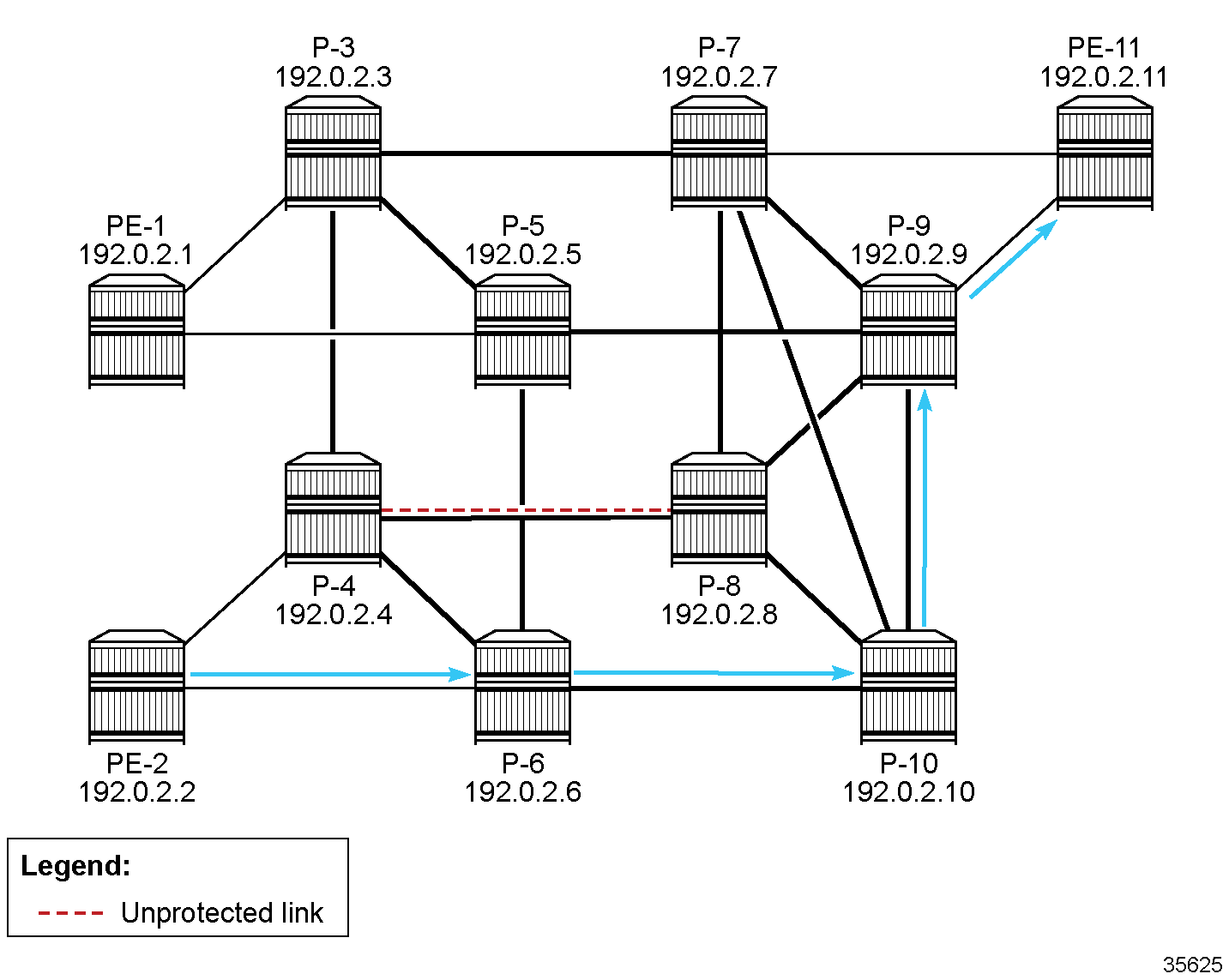
For SR-TE LSP "LSP-PE-2-PE-11_empty-path_localCSPF_protection-none", the path should only use unprotected links, but only the adjacency between P-4 and P-8 is unprotected, so CSPF cannot find an end-to-end path. The path and the LSP remain operationally down with failure code noCspfRouteToDestination, as follows:
*A:PE-2# show router mpls sr-te-lsp "LSP-PE-2-PE-11_empty-path_localCSPF_protection-none" path detail

===============================================================================
MPLS SR-TE LSP LSP-PE-2-PE-11_empty-path_localCSPF_protection-none
Path  (Detail)
===============================================================================
Legend :
    S      - Strict                      L      - Loose
    A-SID  - Adjacency SID               N-SID  - Node SID
    +      - Inherited
===============================================================================
-------------------------------------------------------------------------------
LSP SR-TE LSP-PE-2-PE-11_empty-path_localCSPF_protection-none
Path  empty-path
-------------------------------------------------------------------------------
LSP Name    : LSP-PE-2-PE-11_empty-path_localCSPF_protection-none
Path LSP ID      : 54784
From             : 192.0.2.2
To               : 192.0.2.11
Admin State      : Up                      Oper State        : Down
Path Name   : empty-path
Path Type        : Primary
Path Admin       : Up                      Path Oper         : Down
Path Up Time     : 0d 00:00:00             Path Down Time    : 0d 00:04:31
Retry Limit      : 0                       Retry Timer       : 30 sec
Retry Attempt    : 10                      Next Retry In     : 16 sec

PathCompMethod   : local-cspf              OperPathCompMethod: N/A
MetricType       : igp                     Oper MetricType   : N/A
LocalSrProt      : none                    Oper LocalSrProt  : N/A
LabelStackRed    : Disabled                Oper LabelStackRed: N/A
---snip---

IGP/TE/Del Metric: N/A                     Oper Metric       : N/A
Oper MTU         : N/A                     Path Trans        : 0
Degraded         : False
Failure Code     : noCspfRouteToDestination
Failure Node     : 192.0.2.2
Explicit Hops    :
    No Hops Specified
Actual Hops      :
    No Hops Specified

---snip---
Conclusion
Within a single-level IS-IS network or a single-area OSPF network, SR-TE LSP path calculation using local CSPF on the head-end router results in an end-to-end path using IPv4 adjacencies. The local CSPF path computation method can also be used for RSVP-TE LSPs.