
Introduction to CUPS
The cloud-native version of the Multi-Access Gateway supports wireline use cases. The cMAG-c functions as the control plane in a CUPS architecture, managing user planes and using BBF-defined interfaces for subscriber and network configurations.
CUPS is a subscriber-focused architecture that was first adopted for mobile core. Initially, it appeared in the 4G long-term evolution (LTE) mobile core and later became the standard architecture for the 5G core. In 2019, the Broadband Forum (BBF) began standardization of the BNG CUPS architecture. Nokia was one of the pioneer contributors at BBF in BNG CUPS standardization, which led to the publication of TR-459 for broadband applications, TR-459.2 for NAT, and TR-459.3 for multicast. BBF continues to define new standardized features and solutions contributed by service providers and vendors.
Multi-Access Gateway
Nokia offers the Multi-Access Gateway (MAG) solution with an access-agnostic core that supports both broadband wireline and fixed wireless use cases. Today, the MAG solution can be deployed in a virtualized network function (VNF) environment or a cloud-native (CN) environment. Nokia refers to the CN version of the MAG as the containerized MAG controller (cMAG-c). The cMAG-c supports wireline use cases, as defined by BBF.
- state control interface (SCi)
- in-band control plane (IBCP), also referred to as control packet redirect interface (CPRi)
- management interface (Mi)
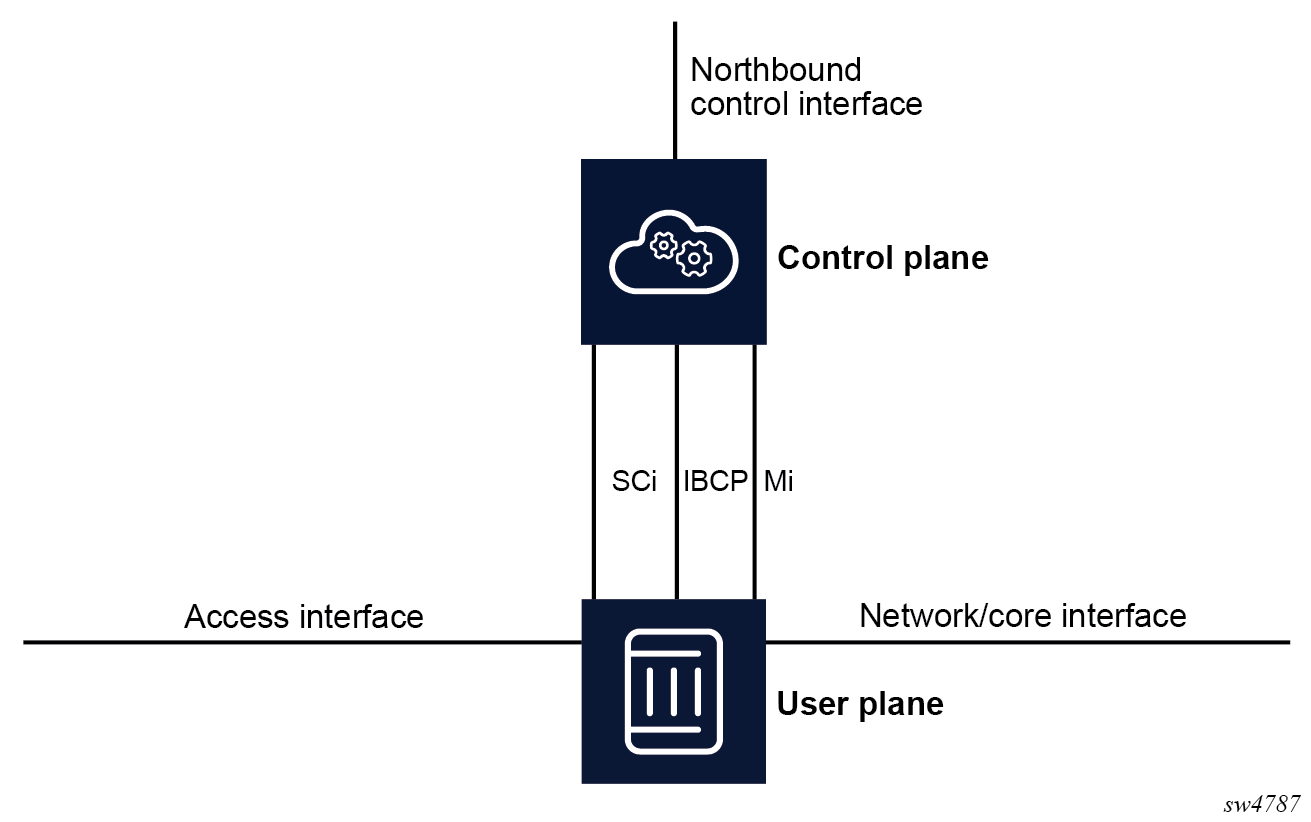
BBF defines BNG CUPS as a disaggregated BNG (DBNG), where the CP of the DBNG is known as the DBNG-CP and the UP of the DBNG is known as the DBNG-UP. The DBNG-CP in the context of this document is the Nokia cMAG-c. The following terms are used interchangeably in the industry: DBNG and BNG CUPS
cMAG-c control plane overview
The Nokia cMAG-c provides subscriber management functions including authentication, authorization and accounting (AAA), IP address management, and policy management. The cMAG-c has northbound control interfaces (NCIs) to communicate with external systems such as remote authentication dial-in user service (RADIUS) servers and policy services. The cMAG-c uses standard interfaces defined in TR-459 to interact with the UP for basic broadband functions. Nokia innovation includes many more added features to enrich functionalities, efficiency, resiliency, and performance improvements.
DBNG-UP overview
- traffic management, including NAT and multicast replication
- policy enforcement, such as QoS and charging
- subscriber traffic statistics
cMAG-c interfaces
The Nokia cMAG-c supports BBF defined standard CUPS interfaces.
State control interface
The SCi is responsible for programming subscriber data forwarding rules on the UP. The cMAG-c solution uses the 3GPP packet forwarding control protocol (PFCP) protocol as specified in 3GPP TS 29.244. 3GPP designed the PFCP to be fully extensible. To accommodate the broadband wireline use case, BBF extended the PFCP information elements (IEs) and published the extension in TR-459. Nokia extended the PFCP IE set to offer additional feature sets.
For wireline access, the SCi programs, at minimum, the following types of rules:
- control packet redirection rules – bidirectional rules to redirect subscriber wireline control packets, via the UP, from the residential gateway (RG) to the cMAG-c and from the cMAG-c to the RG
- subscriber data forwarding rules – bidirectional rules to forward subscriber traffic between the access interface and the network interface
In-band control plane interface
- per-session IBCP tunnels
- common IBCP tunnels
Management interface
The cMAG-c uses the Mi to program the DBNG-UP for everything that is not related to subscriber forwarding rules. BBF TR-459 has no specifications for this interface.