Ethernet ring protection
Overview
The LNW70/170 circuit pack supports rapid (50ms) Ethernet ring protection switching for Ethernet links connected in a ring configuration. Ethernet ring protection is provisionable on Fast Ethernet LAN ports, Gigabit Ethernet LAN ports, and VCGs.
Architecture
Figure 4-7, Ethernet ring protection (normal state) shows a four-node ring. One of the links on node 4 has been provisioned to be the Ring Protection Link (RPL). The provisioned RPL is blocked by default for normal traffic. Node 4 is the RPL Owner, and blocks traffic bidirectionally. Switching is revertive; that is, when a failure clears in the ring, the RPL is blocked (after a wait-to-restore delay).
Figure 4-7: Ethernet ring protection (normal state)
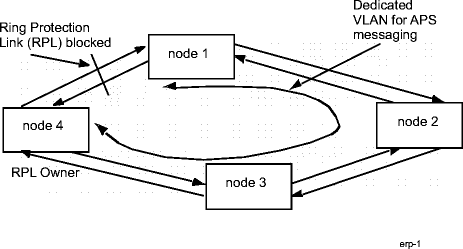
The ring has a VLAN dedicated to APS signaling, called the R-APS channel. Messages are R-APS PDUs. When a change occurs in the ring, 3 R-APS PDUs are sent quickly; otherwise, R-APS PDUs are sent every 5 seconds. Under most conditions, only a single node in the ring is sending R-APS messages.
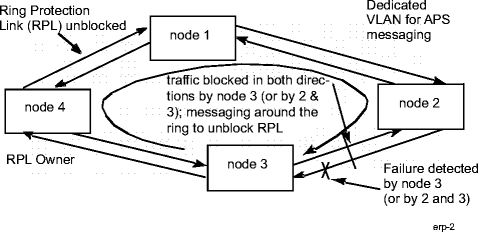
The link that is blocked in the ring is blocked bidirectionally by the RPL Owner, or by the nodes detecting a failure. The R-APS channel within a blocked link is also partially blocked. It does not forward any messages it receives, but the node can initiate or receive messages.
Figure 4-8, Ethernet ring protection (failure state) shows the same four-node ring after a failure. The failure may be detected by a single node, or by both nodes connected to the link. The nodes detecting the failure block the failed link bidirectionally, and send signal failure (SF) R-APS messages around the ring. Each node receiving the message flushes its filtering database (unless the R-APS message indicates otherwise). The node that was blocking a link unblocks it.
Figure 4-8: Ethernet ring protection (failure state)
Reference
For more information about provisioning Ethernet ring protection, refer to the Alcatel-Lucent 1665 Data Multiplexer (DMX) User Operations Guide, 365-372-301.