Allowable cross-connections
Overview
Alcatel-Lucent 1665 DMXtend utilizes several types of SONET, DSn/Electrical, and Ethernet cross-connections, including:
Note: This section summarizes the supported cross-connections. For the complete matrix, see Appendix E in Alcatel-Lucent 1665 Data Multiplexer Extend (DMXtend) TL1 Message Details, 365-372-328.
Add/drop
All connections from a high-speed interface to a low-speed interface are considered add/drop. An add/drop cross-connection is bidirectional cross-connection between a high speed interface and a low speed interface. Alcatel-Lucent 1665 DMXtend also supports unidirectional add and drop cross-connections. A signal can also be add/dropped from electrical and Ethernet interfaces.
Unidirectional path switched ring (UPSR)
A UPSR is self-healing ring configuration in which traffic is sent onto both rotations (both fibers) of the ring in opposite directions. "Path-switched" means that if the working signal fails, the path switches to the protection signal. UPSRs operate in an integrated, single ended fashion- negating the need for complex network-level coordination in the effort to restore traffic.
Unprotected UPSR
Alcatel-Lucent 1665 DMXtend provides an equipment-unprotected cross-connect mode, referred to as unprotected UPSR, on OC-3/12/48 low-speed ports and OC-12/48/192 high-speed UPSRs. This option is user-provisionable on a per cross-connection basis and supports single- and dual-homed ring on ring topologies.
Unprotected UPSR is only supported in shelves with VLF mains. Alcatel-Lucent 1665 DMXtend allows both rotations of a ring to be used simultaneously. Alcatel-Lucent 1665 DMXtend permits simultaneous 1WAY cross-connections sourced from the 2 associated ring channels in a UPSR application, simultaneous 1WAY cross-connection sourced from a ring channel, and 1WAY or 1WAYPR destined to the associated ring channel.
0x1Sn
0x1Sn is not supported when Alcatel-Lucent 1665 DMXtend is equipped with VLF Main packs (LNW84/LNW141). VLF Main packs are required to make true 0x1 cross-connections available.
With 0x1Sn, the OC-n 0x1 provisioning and alarming capability provides the user with a method of provisioning a LS OC-n port in one slot of a slot pair to operate as an unprotected interface. Cross-connections to 0x1Sn ports are provisioned using the ring channel AIDs corresponding to the active side/port. The inactive port, if equipped, always outputs STS1 UNEQ or AIS-P on all tributaries, as a function of the system default idle signal provisioning.
Cross-connections are supported between 0x1Sn ports and all other interface types. For DHA applications, 1WAYPR and 1WAY cross-connections between a 0x1Sn port to a UPSR ring channel are required. Cross-connections supported at all rates supported by the LS OC-n port. Multipoint and unswitched cross-connections to 0x1Sn interfaces are not supported.
Figure 6-5, Two-way add/drop, unswitched, and 0x1Sn shows high-level schematics of two-way add/drop, unswitched, and 0x1Sn cross-connections. The schematic on the top left of the figure is not accurate for systems equipped with VLF Mains. When an Alcatel-Lucent 1665 DMXtend is equipped with VLF Mains, there is no switching in the low-speed fabrics. The schematic on the lower left depicts unswitched connectivity.
Figure 6-5: Two-way add/drop, unswitched, and 0x1Sn
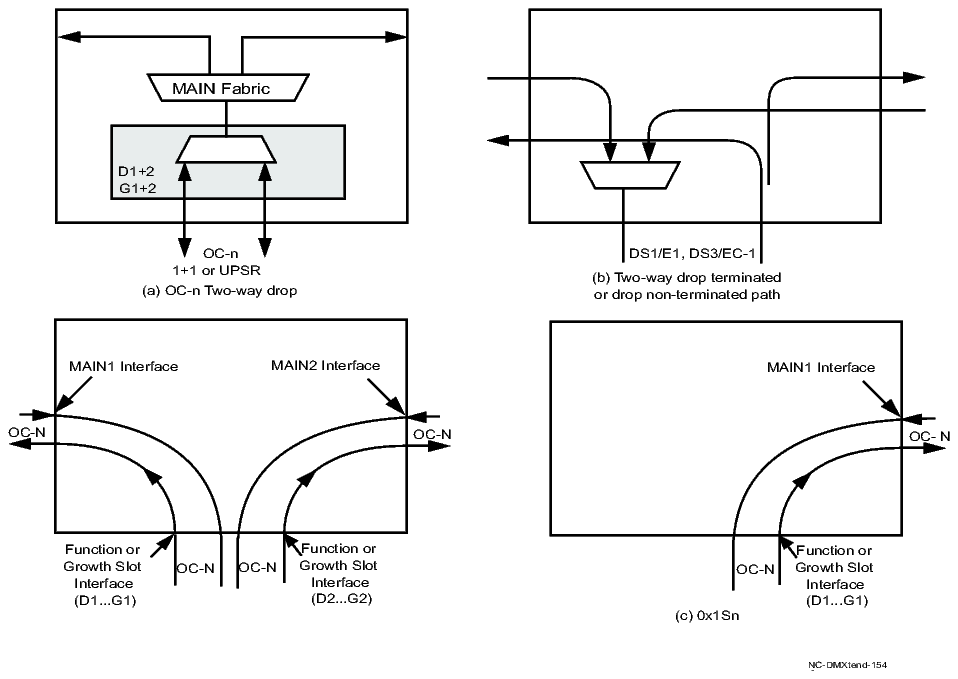

True 0x1
The VLF Main packs (LNW84/LNW141), Alcatel-Lucent 1665 DMXtend support true 0x1 unprotected circuit packs. That means that any slot can be equipped with any pack (some restrictions apply). Two of the same circuit packs can also populate adjacent slots in the same group (this includes some Ethernet packs). For detailed information on circuit pack/slot equipage restrictions in 0x1 mode, see Very large fabric (VLF) engineering rules.
In the case of SONET packs, all ports in a pack must be set to 0x1 application in order for a different pack to be used in the companion slot. If any pair of lines is provisioned for a protected application (1+1, UPSR), then both packs in the group must be of the same type.
True 0x1 replaces 0x1Sn functionality when VLF Mains are used. True 0x1 supports all the capabilities 0x1Sn allow, but adds the capability for both slots of a single group to function independently. 0x1Sn is still supported when the shelf is equipped with non-VLF Mains. True 0x1 is available on the low-speed/tributary packs, and on VLF Main (M1/M2) interfaces.
When two circuit packs in the same low-speed group are operating in 0x1 mode, all provisioning, reporting and retrieval (of alarms) associated with the pack, ports and tributaries in Slot 1 are independent of the provisioning, reporting and retrieval associated with the pack, ports and tributaries in Slot 2.
When provisioned for 0x1 operation, the affect on service and severity of alarms issued against a pack in Slot 1 of a particular group are independent from the affect on service and the severity of the alarms issued against the pack in Slot 2 of that group.
When Alcatel-Lucent 1665 DMXtend is equipped with VLF Mains, all 1-way cross-connections supported on an unprotected port/line (including ports/lines on an unprotected pack) in one slot of a group can be supported independently and simultaneously on an unprotected port/line in either slot of a Function or Growth group. 1-waypr cross-connections are not allowed to be sourced from 0x1 interfaces.
True 0x1 enables hairpin cross-connections between channels on packs in different slots of the same group.
Pass-through
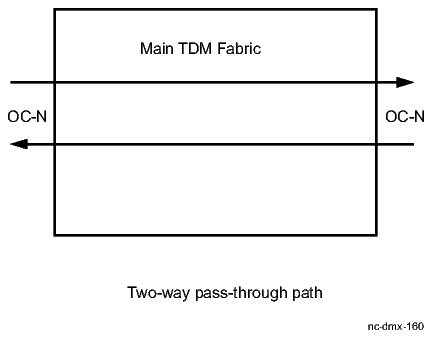
A pass-through cross-connection is made between two ring interfaces in the same MAIN or Function Unit group, allowing the signal to be "passed-through" a ring node on the same time slot.
The figure below shows a pass-through cross-connection on the high-speed interface (OC-12, OC-48, or OC-192).
Figure 6-6: Pass-through cross-connection on high-speed interface
Low-speed pass-throughs
Alcatel-Lucent 1665 DMXtend can host multiple rings on the low-speed interfaces of the Alcatel-Lucent 1665 DMXtend shelf. This is accomplished by intra-function group, pass-through cross-connections. Alcatel-Lucent 1665 DMXtend can close a low-speed ring by supporting a cross-connection between a receive port on one circuit pack and a transmit port on another circuit pack in the same function or growth group. All protection switching advantages/capabilities still apply in VT and STS-n Ring Closure applications. When VLF Main packs are used, all cross-connect switching occurs on the main packs, including low-speed, tributary pass-through cross-connects. This means that the line depicting the pass-through cross-connect in the figure below would have to extend out of the tributary packs, up into the MAIN switch fabric at the top of the figure when VLF Mains are used.
Figure 6-7: Pass-through hairpin
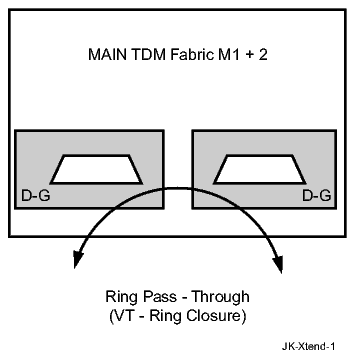
Alcatel-Lucent 1665 DMXtend also supports inter-function group hairpins and intra-port hairpins. Inter-function group hairpins are cross-connections between ports located in different function groups (for example: between a port found in D1 and one found in G1).
Intra-port hairpins are cross-connections between channels hosted by the same physical port of the Alcatel-Lucent 1665 DMXtend shelf and are only supported on 1+1 interfaces.
Intra-function group hairpins are cross-connections between different ports in the same function group.
SONET hairpinning cross-connections
If VLF Main packs are used in “hairpinning” topologies, all cross-connect and switching functions are centralized on the Main pack. Switching within the fabrics on the tributary (low-speed) OLIUs is disabled and traffic is routed directly to the STS fabric on the Mains, bypassing any VT fabric on the tributary OLIUs. When VLF Main packs are not used, tributary (low-speed) traffic is routed into the system and back out without ever being placed on high-speed (OC-12, OC-48 or OC-192) interfaces. In addition, in systems with non-VLF mains, VT cross-connections on the LNW45 and LNW49 are optimized to minimize the VT fabric usage on the main packs. For example, hairpins between different VTs on an LNW45 or LNW49 are routed using only the VT fabric on the LNW45 or LNW49, and thus do not consume any VT resources on the main packs.
Alcatel-Lucent 1665 DMXtend is capable of connecting any input on a circuit pack in a function or growth slot to any output in the same group (known as inter-fn hairpin). Alcatel-Lucent 1665 DMXtend also supports intra-port hairpins, by which Alcatel-Lucent 1665 DMXtend can hairpin between different tributaries on the same port.
When VLF Main circuit packs are not installed, hairpin cross-connections to 0x1Sn interfaces are supported. When VLF Main circuit packs are installed, hairpin cross-connections between unprotected ports on different slots of the same low-speed group are supported. Certain restrictions apply, see Very large fabric (VLF) engineering rules.
These flexible cross-connect capabilities allow you to use a combination of add/drop and hairpinning of compatible payloads through a variety of interfaces.
Alcatel-Lucent 1665 DMXtend supports intra-function group, hairpin cross-connections that are cross-connections between different tributaries on different ports within the same function group. Intra-port hairpins are cross-connections between channels hosted by the same physical port of the Alcatel-Lucent 1665 DMXtend shelf. These intra-port hairpins are only supported on 1+1 protected interfaces.
The figure below shows some of the various SONET hairpinning schemes.
Figure 6-8: SONET hairpinning
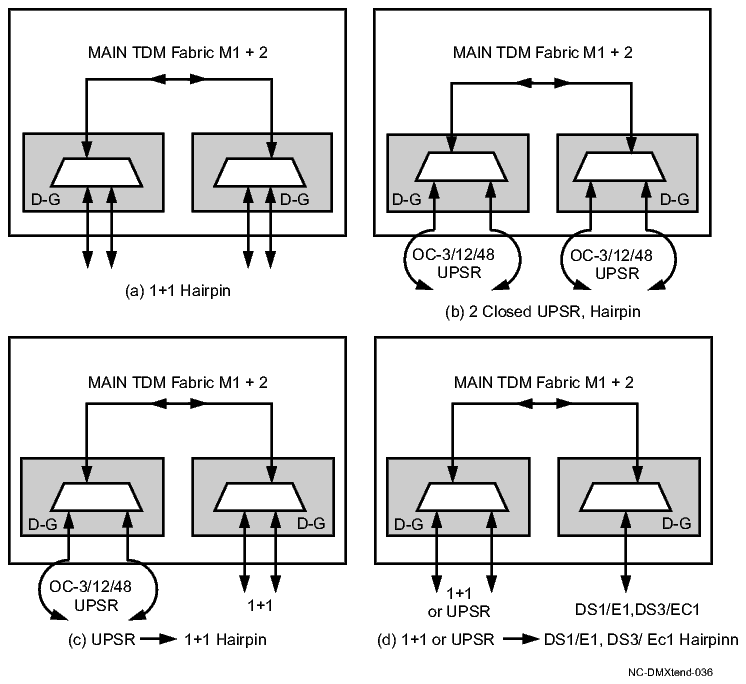
Important! The schematics above are accurate for systems equipped with non-VLF mains. When Alcatel-Lucent 1665 DMXtend is equipped with VLF mains, all switching occurs on the fabrics in the Main packs.
Portless mode hairpin cross-connections (LNW20)
When operating in portless mode, LNW20 pulls DS1s from channelized DS3 signals that enter Alcatel-Lucent 1665 DMXtend on a SONET STS-1 interface (on another pack) and converts them to VT mapped STS-1s. This VT-mapped STS-1 is cross-connected at the VT level in the Main packs (at least one side of the cross-connect is OCn/EC1) to any interface that supports the signal structure today (DS1, channelized DS3, EC1, optical). For portless functionality, incoming STS-1s must contain a channelized DS3. This STS-1 is cross-connected to the LNW20 and then hairpinned to the STS fabric on the Main pack. Once the signal is finally converted to a VT1.5 it can be cross-connected to any port that accepts that signal format.
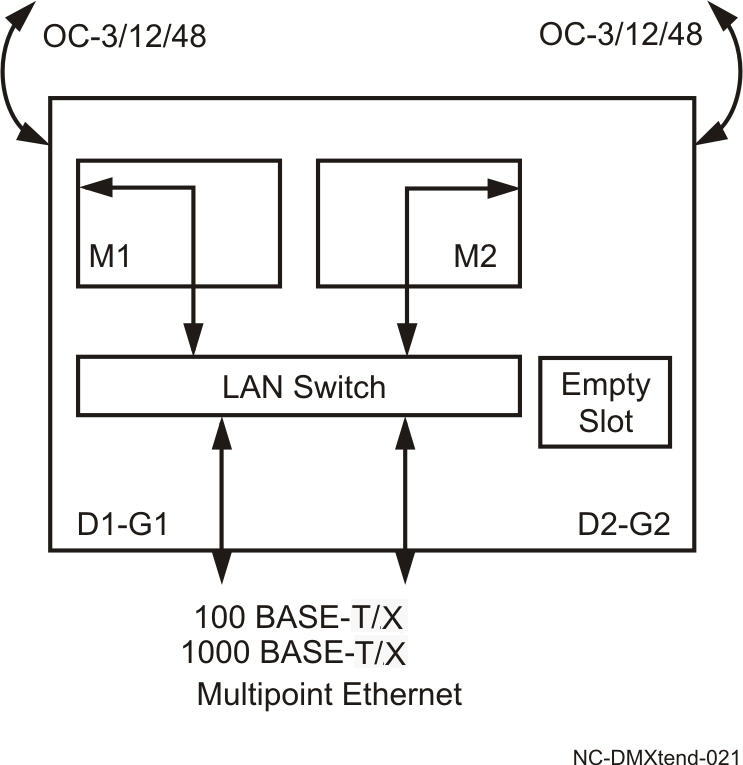
Multi-point (Ethernet only)
The data-specific multi-point cross-connect is a bidirectional cross-connection between two STS-1 Virtual Concatenation Group (VCG) on 100/1000BASE-X/T and ports to two different ring interfaces (UPSR).
The figure below shows Ethernet Multipoint cross-connection schematic.
Figure 6-9: Ethernet multi-point cross-connection
Ethernet hairpining cross-connections
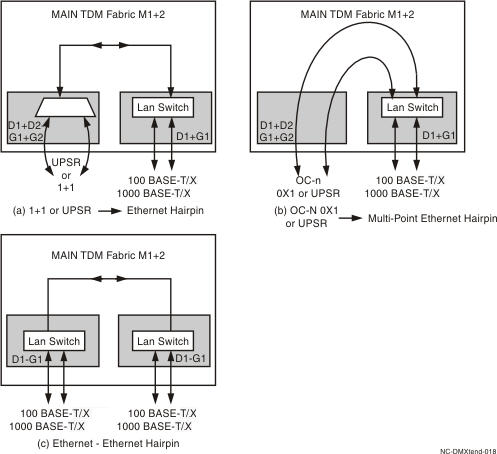
With Ethernet-to-Ethernet hairpinning, traffic may travel from one Ethernet port on a circuit pack in one set of slots, to another port on a circuit pack in a different set of slots (from D1 to G1, for example). From there, the traffic may be multiplexed with other packet traffic before being switched onto another Ethernet or SONET interface.
In shelves equipped with VLF Mains (LNW84/LNW141), hairpins between 0x1 compatible Ethernet packs located in Slot 1 and Slot 2 of the same group are also supported. For detailed information regarding 0x1 circuit pack compatibility, see Very large fabric (VLF) engineering rules.
The figure below shows some of the high-level schematics of Ethernet hairpinning cross-connections.
Figure 6-10: Ethernet hairpinning
Multi-point Ethernet combinations
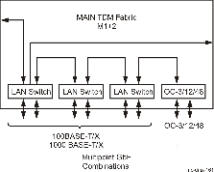
Alcatel-Lucent 1665 DMXtend supports Multi-point Ethernet cross-connections from one Ethernet interface (D1–G1) to all of the following interfaces:
Figure 6-11: Multi-point combinations
Ethernet circuit pack capacities summary
The table below details various characteristics of the Ethernet and FC-DATA (SAN) circuit packs. The table covers the rate, transport format (PL or Switched), differential delay, frame size, LCAS capability, OSP capability as well as the number, format and capacity of VCGs supported by each Ethernet circuit pack.
Table 6-13: Ethernet circuit pack capacities summary part 1
|
Pack |
Rate (# of ports) |
PL or Switched |
VCG Ports |
VCG Format and Capacity (Max # of tributaries per VCG) 1 | |||||
|---|---|---|---|---|---|---|---|---|---|
|
VT1.5- xv |
STS-1 |
STS-1- xv |
STS-3c |
STS-3c- xv |
STS-12c | ||||
|
LNW63 1G SX/LX/ ZX PL |
1000BASE-T, 1000BASE-X (4) |
PL |
4 |
- |
1 |
21 |
1 |
7 |
1 |
|
LNW64 1G SX/LX/ ZX PL |
1000BASE-T, 1000BASE-X (8) |
PL |
8 |
- |
1 |
21 |
1 |
7 |
1 |
|
LNW73/ 73C FC-DATA (SAN) |
FC-1G/FICON (4) ORESCON (4) |
PL |
4 |
- |
1 FC -FICON 1 ESCON |
48 FC- FICON 6 ESCON |
1 FC- FICON 1 ESCON |
16 FC- FICON 2 ESCON |
1 FC- FICON 1 ESCON |
|
LNW74 10/100 T/F |
100BASE-T (16) 100BASE-ZX/LX/FX (8 PTM) |
PL |
24 |
63 |
1 |
3 |
1 |
- |
- |
|
LNW87 FE/GBE PL |
100BASE-ZX/LX/FX (4 PTM) |
PL |
4 |
- |
1 |
21 |
1 |
7 |
1 |
|
1000BASE-SX/LX/ZX/ (4 PTM) |
- |
1 |
3 |
1 |
- |
- | |||
|
LNW170 100/1G FS 2 |
100BASE-ZX/LX/FX/T (4 PTM) 1000BASE-SX/LX/ZX/T (4 PTM) |
PL / Switched |
1–2 |
- |
1 |
48 |
1 |
16 |
1 |
|
3–28 |
- |
1 |
32 |
1 |
10 |
1 | |||
|
29–32 |
- |
1 |
10 |
1 |
3 |
- | |||
|
LNW910 FE/GBE/ 10GBE |
100/1000BASE-T (industrial temp), 100BASE-LX, 1000BASE-SX/LX/ZX (10 PTM) 10GBASE-LR/ER/ZR(1 PTM) |
PL |
1–10 |
- |
21 |
7 |
1 |
||
|
11 |
- |
192 |
64 |
1 |
1 |
1 | |||
|
Switched |
1–60 |
- |
21 |
7 |
1 |
||||
|
61–64 |
- |
192 |
64 |
1 |
1 |
1 | |||
Notes:
Every pack other than the LNW64, supports a maximum of 2.5G (48 STS-1) between any function slot and the backplane, double (5G) with multipoint cross-connections. The LNW64 has a maximum backplane capacity of 10G (192 STS-1s).
VCG 1–2 can support up to 48 STS1s or 16 STS3cs for a 2.5G. VCG 3–28 support up to 32 STS1s or 10 STS3cs. VCG 29–32 support up to 10 STS1s or 3 STS3cs.
Table 6-14: Ethernet circuit pack capacities summary part 2
|
Pack |
Slots where packs can reside |
Backplane Capacity |
Differential Delay (ms) |
LCAS Support |
Maximum Frame Size |
OSP |
|---|---|---|---|---|---|---|
|
LNW63 GbE PL |
D–G |
48 STS-1s |
50 |
Y |
10222 |
Y |
|
LNW64 GbE PL |
D–G |
168 STS-1s |
108 |
Y |
10222 |
Y (optical PTM/SFPs only) |
|
LNW73/73C FC-DATA (SAN) |
D–G |
38 STS-1s |
120 |
Y 1 |
2160 2 |
- |
|
LNW74 10/100 T/F |
D–G |
48 STS-1s 63 VT1.5s |
64 |
Y |
9614 |
Y |
|
LNW87 FE/GBE PL |
D–G |
84 STS-1s |
108 |
Y |
10222 |
Y |
|
LNW170 100/1G FS |
D–G |
48 STS-1s |
50 |
Y |
10222 |
- |
|
LNW910 FE/GBE/10GBE |
D–G |
192 STS-1s |
64 |
Y |
10222 |
Y |
Notes:
Ethernet circuit pack capacities for ring configurations
The table below details the allowable Ethernet-related ring configurations (Ethernet applications within UPSR topologies) and the number of these configurations that may be supported by each Ethernet circuit pack in Alcatel-Lucent 1665 DMXtend.
Important! Capacities for each configuration are available in the later of the release numbers shown at the left of the row and the top of the column.
For more information, see Ethernet packet rings, Ethernet Private Line (point-to-point Ethernet) for enterprise LAN transport, and CIR and PIR rate shaping, in Chapter 3, Applications and configurations.
Table 6-15: Ethernet circuit pack capacities for ring configuration
|
Config |
Release |
Circuit Packs | |||||
|---|---|---|---|---|---|---|---|
|
1000 Mbps (GbE-PL) (4-port/ 8-port) |
10/100 Mbps (FE-BPR) |
10/100 Mbps (FE-EPL)/ 1000 Mbps (GbE-PL) |
10/100 Mbps (FE-EPL) |
10/100/ 1000 Mbps (FE/ GbE- BPR) |
10/100/ 1000 Mbps (FE/ GbE- EoS) | ||
|
Packet Rings on UPSRs |
1.1 |
2/4 |
1 |
0 |
0 |
16 |
1 |
|
PL on UPSR w/ UPSR protection |
1.1 |
2/4 |
1 |
16–24 |
16–24 |
16–32 |
6 |
|
PL on UPSR w/out UPSR protection |
1.1 |
2/4 |
2 |
16–24 |
NA |
16–32 |
6 |
|
BPR= Basic Packet Ring | |||||||
|
EPR= Enhanced Packet Ring (w/ rate control) | |||||||
|
EPL= Ethernet Private Line (point-to-point) PL= Private Line (point-to-point) | |||||||
|
FE= Fast Ethernet (10/100 Mbps) GbE= Gigabit Ethernet (1000 Mbps) | |||||||
|
FC-DATA= SAN card (FICON/ESCON/FC) | |||||||
Notes:
The number of EPL cross-connections on the LNW74 is relative to the slot in which the circuit pack is housed and not the cross-connection rate. 24 VCGs are provisionable in slot D. 8 VCGs are provisionable in slot G.
Allowable UPSR add-drop cross-connections
The table below contains a list of UPSR add-drop cross-connections supported by Alcatel-Lucent 1665 DMXtend. The cross-connections in the table below are all drop cross-connections.
Note: In UPSR networks with more than 2 nodes, mixing VT and STS add/drops in the same circuit can lead to cases where individual VT defects are not protected at the STS-1 add/drop node. If you are provisioning VT add/drops, both ends of the add/drop circuit should be VT1.5 cross-connects; mixing VT add/drops and STS-1 add/drops in a multi-node UPSR is not recommended.
Important! With atomic cross-connects, all cross-connections are one-way. For cross-connects not involving UPSR interfaces, the same 1-way cross-connects are supported in the opposite direction to provide two-way connectivity.
The LNW84/LNW141 VLF Main circuit packs make true 0x1 cross-connections and shelf equipage possible. When the VLF Main pack is used, the shelf does not support 0x1Sn cross-connections, or the LNW7 circuit pack. In shelves equipped with VLF Mains, unprotected (linear) UPSR cross-connections are also supported. Unprotected UPSR cross-connections are independent cross-connections to or from the companion UPSR tributaries. For these reasons, the capabilities of the shelf when equipped with the VLF Main packs are listed separately.
Table 6-16: Allowable UPSR add-drop cross-connections
|
From |
To | |
|---|---|---|
|
VLF Main (LNW84/LNW141) OLIU (UPSR) | ||
|
1-way STS-n ---------------------> |
DS1, E1, DS3, EC-1, TransMUX, OC-3/12/48 (1+1, UPSR, 0x1), 100/1000BASE-X/T, FC-DATA | |
|
1-way VT1.5--------> |
DS1, EC-1, TransMUX, OC-3/12/48 (1+1, UPSR, 0x1), 100BASE-X/T (LNW74 only) | |
|
1-way unswitched STS-n--------> |
OC-3/12/48 (UPSR) | |
|
1-way unswitched VT1.5--------> |
OC-3/12/48 UPSR | |
|
1-waypr STS-n -------------------> |
DS1, E1, DS3, EC-1, TransMUX, OC-3/12/48 (1+1, UPSR, 0x1), 100/1000BASE-X/T FC-DATA | |
|
1-waypr VT1.5 --------------------> |
DS1, EC-1, TransMUX, OC-3/12/48 (1+1, UPSR, 0x1), 100BASE-X/T (LNW74 only) | |
|
Non-VLF OC-48 High-Speed OLIU (UPSR) | ||
|
1-way STS-n ---------------------> |
DS1, DS3, OC-3/12/48 (0x1Sn) | |
|
1-way VT1.5--------> |
DS1, OC-3/12/48 (0x1Sn) | |
|
1-way unswitched STS-n--------> |
OC-3/12/48 (UPSR), 100/1000BASE-X/T | |
|
1-way unswitched VT1.5--------> |
OC-3/12/48 UPSR | |
|
1-waypr STS-n -------------------> |
DS1, E1, DS3, EC-1, TransMUX, OC-3/12/48 (1+1, 0x1Sn, UPSR), 100/1000BASE-X/T, FC-DATA | |
|
1-waypr VT1.5 --------------------> |
DS1, EC-1, TransMUX, OC-3/12/48 (0x1Sn, 1+1 and UPSR), 100BASE-X/T (LNW74 only) | |
|
Non-VLF OC-12 High-Speed OLIU (UPSR) | ||
|
1-way STS-n ---------------------> |
DS1, DS3, OC-3/12/48 (0x1Sn) | |
|
1-way VT1.5--------> |
DS1, OC-3/12/48 (0x1Sn) | |
|
1-way unswitched STS-n--------> |
OC-3/12/48 (UPSR), 100/1000BASE-X/T | |
|
1-way unswitched VT1.5--------> |
OC-3/12/48 UPSR | |
|
1-waypr STS-n -------------------> |
DS1, E1, DS3, EC-1, TransMUX, OC-3/12/48 (1+1, 0x1Sn, UPSR), 100/1000BASE-X/T, FC-DATA | |
|
1-waypr VT1.5 --------------------> |
DS1, EC-1, TransMUX, OC-3/12/48 (0x1Sn, 1+1 and UPSR), 100BASE-X/T (LNW74 only) | |
|
Non-VLF OC-3 High-Speed OLIU (UPSR) | ||
|
1-way STS-n ---------------------> |
DS1, DS3, TransMUX, OC-3/12/48 (0x1Sn) | |
|
1-way VT1.5--------> |
DS1, DS3, OC-3/12/48 (0x1Sn) | |
|
1-way unswitched STS-n--------> |
OC-3/12/48 (UPSR), 100/1000BASE-X/T | |
|
1-way unswitched VT1.5--------> |
OC-3/12/48 UPSR | |
|
1-waypr STS-n -------------------> |
DS1, E1, DS3, EC-1, TransMUX, OC-3/12/48 (1+1, 0x1Sn, UPSR), 100/1000BASE-X/T, FCDATA | |
|
1-waypr VT1.5 --------------------> |
DS1, EC1, TransMUX, OC-3/12/48 (0x1Sn, 1+1 and UPSR), 100BASE-X/T (LNW74 only) | |
Important! In systems equipped with non-VLF main, 1way cross-connects FROM UPSR to E1, TMUX or Ethernet/Data interfaces are not supported. In systems equipped with VLF mains 1way cross-connections from a UPSR are supported to all interfaces.
Allowable 1+1 add-drop cross-connections
The table below contains a list of linear/bidirectional (1+1) add-drop cross-connections supported by Alcatel-Lucent 1665 DMXtend. The cross-connections in the table below are all drop cross-connections.
Important! Alcatel-Lucent 1665 DMXtend uses atomic cross-connects, all cross-connections are one-way. For cross-connects not involving UPSR interfaces, the same 1-way cross-connects are supported in the opposite direction to provide two-way connectivity.
Table 6-17: Allowable 1+1 add-drop cross-connections
|
From |
To | |
|---|---|---|
|
VLF Main (LNW84/LNW141) OLIU (1+1) | ||
|
1-way STS-n ---------------------> |
DS1, E1, DS3, EC-1, TransMUX, OC-3/12/48 (1+1, UPSR, 0x1), 100/1000BASE-X/T, FC-DATA | |
|
1-way VT1.5--------> |
DS1, EC-1, TransMUX, OC-3/12/48 (1+1, UPSR, 0x1), 100BASE-X/T (LNW74 only) | |
|
Non-VLF OC-48 High-Speed OLIU (1+1) | ||
|
1-way STS-n ---------------------> |
DS1, E1, DS3, EC-1, TransMUX, OC-3/12/48 (1+1, 0x1Sn, UPSR), 100/1000BASE-X/T, FC-DATA | |
|
1-way VT1.5--------> |
DS1, TransMUX, OC-3/12/48 (1+1, 0x1Sn, UPSR), and 100BASE-X/T | |
|
Non-VLF OC-12 High-Speed OLIU (1+1) | ||
|
1-way STS-n ---------------------> |
DS1, E1, DS3, EC-1, TransMUX, OC-3/12/48 (1+1, 0x1Sn, UPSR), 100/1000BASE-X/T, FC-DATA | |
|
1-way VT1.5--------> |
DS1, TransMUX, OC-3/12/48 (1+1, 0x1Sn, UPSR), and 100BASE-X/T | |
|
Non-VLF OC-3 High-Speed OLIU (1+1) | ||
|
1-way STS-n ---------------------> |
DS1, E1, DS3, EC-1, TransMUX, OC-3/12/48 (1+1, 0x1Sn, UPSR), 100/1000BASE-X/T, FC-DATA | |
|
1-way VT1.5--------> |
DS1, EC-1, TransMUX, OC-3/12/48 (1+1, 0x1Sn, UPSR), 100BASE-X/T (LNW74 only) | |
Allowable UPSR pass-through cross-connections (high-speed interface)
Alcatel-Lucent 1665 DMXtend supports direct pass-through cross-connections from a particular time slot on one side of a UPSR to/from the same time slot on the other side of the ring. Pass-through cross-connections are available at the same rates as add/drop cross-connections.
Allowable hairpin cross-connections
The table below contains a list of hairpin cross-connections supported by Alcatel-Lucent 1665 DMXtend. The cross-connections in the table below are all Hairpin cross-connections.
Table 6-18: Allowable hairpin cross-connections
|
From |
To | |
|---|---|---|
|
OC-3/12/48 (1+1) | ||
|
1-way STS-n ---------------------> |
DS1, E1, DS3, EC-1, TransMUX, OC-3/12/48 (1+1, UPSR, 0x1, 0x1Sn), 100/1000BASE-X/T, FC-DATA | |
|
1-way VT1.5--------> |
DS1, EC-1, TransMUX, OC-3/12/48 (1+1, UPSR, 0x1, 0x1Sn), 100BASE-X/T (LNW74 only) | |
|
OC-3/12/48 (UPSR) (non-VLF Mains) | ||
|
1-way STS-n ---------------------> |
DS1, DS3, EC-1, TransMUX, OC-3/12/48 (UPSR), 100/1000BASE-X/T, FC-DATA | |
|
1-way VT1.5--------> |
DS1, OC-3/12/48 ( 0x1Sn) | |
|
1-way unswitched STS-n--------> |
OC-3/12/48 (UPSR), 100/1000BASE-X/T (no LNW74) | |
|
1-way unswitched VT1.5--------> |
OC-3/12/48 UPSR | |
|
1-waypr STS-n -------------------> |
DS1, E1, DS3, EC-1, TransMUX, OC-3/12/48 (1+1, UPSR, 0x1, 0x1Sn), 100/1000BASE-X/T, FC-DATA | |
|
1-waypr VT1.5 --------------------> |
DS1, EC-1, TransMUX, OC-3/12/48 (1+1, UPSR, 0x1, 0x1Sn), 100BASE-X/T (LNW74 only) | |
|
OC-3/12/48 (UPSR) (VLF Mains) | ||
|
1-way STS-n ---------------------> |
DS1, E1, DS3, EC-1, TransMUX, OC-3/12/48 (1+1, UPSR, 0x1), 100/1000BASE-X/T, FC-DATA | |
|
1-way VT1.5--------> |
DS1, EC-1, TransMUX, OC-3/12/48 (1+1, UPSR, 0x1), 100BASE-X/T (LNW74 only) | |
|
1-way unswitched STS-n--------> |
OC-3/12/48 (UPSR) | |
|
1-way unswitched VT1.5--------> |
OC-3/12/48 UPSR | |
|
1-waypr STS-n -------------------> |
DS1, E1, DS3, EC-1, TransMUX, OC-3/12/48 (1+1, 0x1, UPSR), 100/1000BASE-X/T, FC-DATA | |
|
1-waypr VT1.5 --------------------> |
DS1, EC-1, TransMUX, OC-3/12/4 (0x1, 1+1 and UPSR), 100BASE-X/T (LNW74 only) | |
|
OC-3/12/48 (0x1) (requires LNW84/LNW141 VLF Main) | ||
|
1-way STS-n ---------------------> |
DS1, E1, DS3, EC-1, TransMUX, OC-3/12/48 (UPSR, 1+1, 0x1), 100/1000BASE-X/T, FC-DATA | |
|
1-way VT1.5--------> |
DS1, EC-1, TransMUX, OC-3/12/48 (1+1, UPSR, 0x1), 100BASE-X/T (LNW74 only) | |
|
OC-3/12/48 (0x1Sn) (non-VLF Mains only) | ||
|
1-way STS-n ---------------------> |
DS1, E1, DS3, EC-1, TransMUX, OC-3/12/48 (UPSR, 1+1, 0x1Sn), 100/1000BASE-X/T, FC-DATA | |
|
1-way VT1.5--------> |
DS1, EC-1, TransMUX, OC-3/12/48 (1+1, UPSR, 0x1Sn), 100BASE-X/T (LNW74 only) | |
|
OC-3/12/48 Low-Speed OLIU (0x1) (requires LNW84/LNW141 VLF Main) | ||
|
1-way STS-n ---------------------> |
DS1, E1, DS3, EC-1, TransMUX, OC-3/12/48 (UPSR, 1+1, 0x1), 100/1000BASE-X/T, FC-DATA | |
|
1-way VT1.5--------> |
DS1, EC-1, TransMUX, OC-3/12/48 (1+1, UPSR, 0x1), 100BASE-X/T (LNW74 only) | |
|
1-way STS-n ---------------------> |
DS1, E1, DS3, EC-1, TransMUX, OC-3/12/48 (1+1, UPSR, 0x1sn), OC-48 (BLSR), 100/1000BASE-X/T, FC-DATA | |
|
1-way unswitched STS-n--------> |
OC-3/12/48 (UPSR), 100/1000BASE-X/T | |
|
100-FEPL (Private Line) 1 | ||
|
1-way STS-n ---------------------> |
1000BASE-X/T | |
|
TransMUX (LNW18 and LNW20) 1 | ||
|
1-way STS-n ---------------------> |
DS1, TransMUX | |
|
1-way VT1.5 -------> |
DS1, TransMUX | |
|
DS1/E1 1 | ||
|
1-way STS-n ---------------------> |
DS1/E1, TransMUX | |
|
1-way VT1.5 -------> |
DS1/E1, TransMUX | |
|
DS3 1 | ||
|
1-way STS-n ---------------------> |
DS3 | |
|
EC-1 1 | ||
|
1-way STS-n ---------------------> |
EC-1, DS1, TransMUX | |