
Recovery
If the SONiC image in the system becomes corrupted, it may be necessary to perform recovery procedures to correct the image.
Recovery using ONIE
The user can recover a Nokia community SONiC device by reinstalling the SONiC image from a local image through the Open Network Install Environment (ONIE). This method is typically used when it is not possible to boot the existing image.
- Ensure the RS-232 console is connected to the front port; the rate depends on the platform, for example, 9600 baud or 115200 baud.
- Have the ability to power cycle the device.
- Ensure the local image file is available, for example, in the directory /tmp/IMAGE_FILE.bin, on a USB drive or an SD card, or another method supported on your platform (for example, over the network).
Use this procedure for recovery purposes. For a standard upgrade, see Upgrading to a customer-compiled SONiC software image for instructions.
This procedure uses the UEFI GRUB menu and ONIE installer. The boot-timing windows are short.
The examples in this task show reimaging of a 202411 software version.
-
Use the following steps to run the ONIE boot.
- Display the GNU GRUB menu by pressing the up arrow key during power on.
- Select ONIE from the GNU GRUB menu as shown in the following figure.
- Select ONIE: Install OS from the ONIE boot options.
- Go to step 2.
Figure 1. GNU GRUB menu 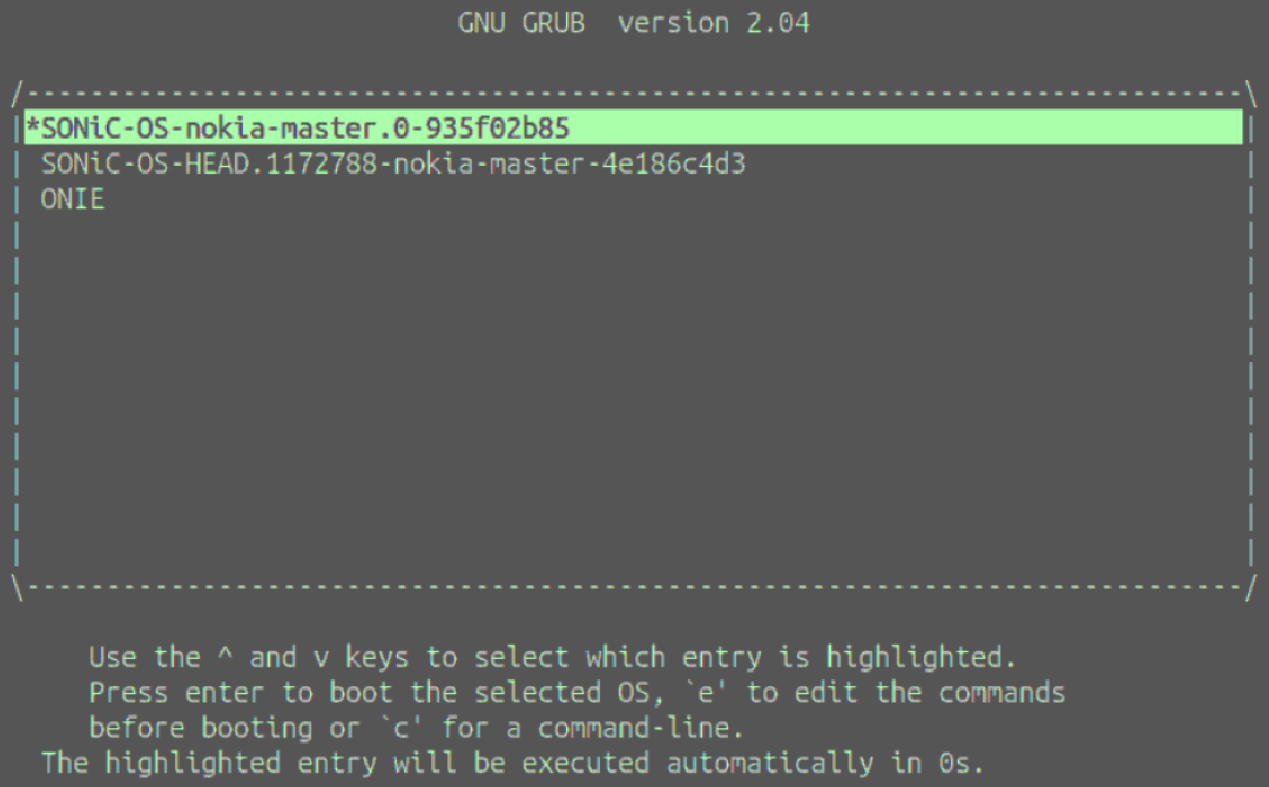 ONIE starts automatic discovery by default.
-
Stop the ONIE automatic discovery before running a manual installation.
ONIE:/ # onie-stop discover: installer mode detected. Stopping: discover... done. -
If you are transferring the SONiC image over the network, configure the
management IP address and default route.
Configure the ONIE management interface and default route
ONIE:/ # ifconfig eth0 10.12.19.7 netmask 255.255.255.0
ONIE:/ # ip route add 0.0.0.0/0 via 10.12.19.1
The management interface and default route are configured for transferring the image over the network. -
Make the SONiC image available locally using one of the following
methods.
- Copy the image over the network using
SCP.
Example
ONIE:/ # scp <user>@<server-with-sonic-image>:<path-to-sonic-image-binary> <local-destination> - Copy the image from a USB drive or SD
card.
Example
ONIE:/ # fdisk -l
ONIE:/ # mkdir /mnt/usb
ONIE:/ # mount /dev/sdb1 /mnt/usb
ONIE:/ # cp /mnt/usb/sonic-image.bin /root/
- Copy the image over the network using
SCP.
-
Reinstall the image (from your local storage, a USB drive or SD card, or over
your network), using the onie-nos-install command.
Reinstall image from local disk
ONIE:/ #
ONIE:/ # ls /tmp
sonic-marvell-prestera-arm64.bin
ONIE:/ #
ONIE:/ # onie-nos-install /tmp/sonic-marvell-prestera-arm64.bin
The system installs the SONiC image. -
After the installation completes, allow the device to reboot and boot the
installed SONiC image.
The device boots using the installed SONiC image and displays the SONiC login prompt.
-
When the reinstallation completes, use the show version
command to verify the SONiC image software version and build details.
admin@router:~$ show version

SONiC Software Version: SONiC.HEAD.1086978-202411-ce988a8c
SONiC OS Version: 13
Distribution: Debian 13.1
Kernel: 6.12.41+deb13-sonic-arm64
Build commit: ce988a8c
Build date: Fri Nov  7 11:55:35 UTC 2025
Built by: gitlab-runner@sonic-armv16

Platform: arm64-nokia_ixs7215_52xb-r0
HwSKU: Nokia-7215-A1
ASIC: marvell
ASIC Count: 1
Serial Number: 124080XXXX
Model Number: 3HE18723AAXXXX
Hardware Revision: 0
The output confirms that the expected SONiC image is reinstalled and active.