
Exponential port dampening
The Interface hold timers feature works best in situations where flapping events are caused by system reconfiguration or when flapping events are rare.
Exponential port dampening (EPD) is similar to the interface hold-timer feature in that it can automatically block a port from reuse for a period of time after port-down/up events. EPD can also address situations where a port or link exhibits flapping where the outage events are repetitive, but they fall outside the preset hold timers. For example, a port may be up for a short period, then fail again shortly thereafter, creating churn in the networking topology. If a series of port-down/up events occur close together, EPD can keep the port in the down state for a longer period than if only one port-down/up event occurred. This prevents the router from using the port when there are events causing the port state to fluctuate. The more port-down/up events that occur, the longer EPD keeps the port down and unavailable for use by the upper-layer routing protocols.
EPD does this by assigning cumulative penalties for each consecutive port-down event and reducing those penalties over time using an exponential decay formula. As a port's state continues to be unstable and the penalties accumulate, EPD can place the port in a suppressed state, preventing the router from reporting port-up events to upper-layer routing protocols. If the port state stabilizes, the accumulated penalties decay over time, and the port is made available to the upper-layer routing protocols again.
EPD assigns a fixed penalty amount per port-down event and applies an exponential decay formula to reduce penalties over time. The exponential decay is defined by the following equation:

Where:
N(t) is the remaining penalty after time t
N0 is the initial penalty quantity
t1/2 is the half-life
N0 refers to the starting penalties from the last port down event. N(t) refers to the decayed penalties at a specific time, and is calculated starting from the last port down event (that is, from when N0 last changed).
The following figure shows how EPD assigns penalties to suppress the state of a port with frequent port-down/up events.
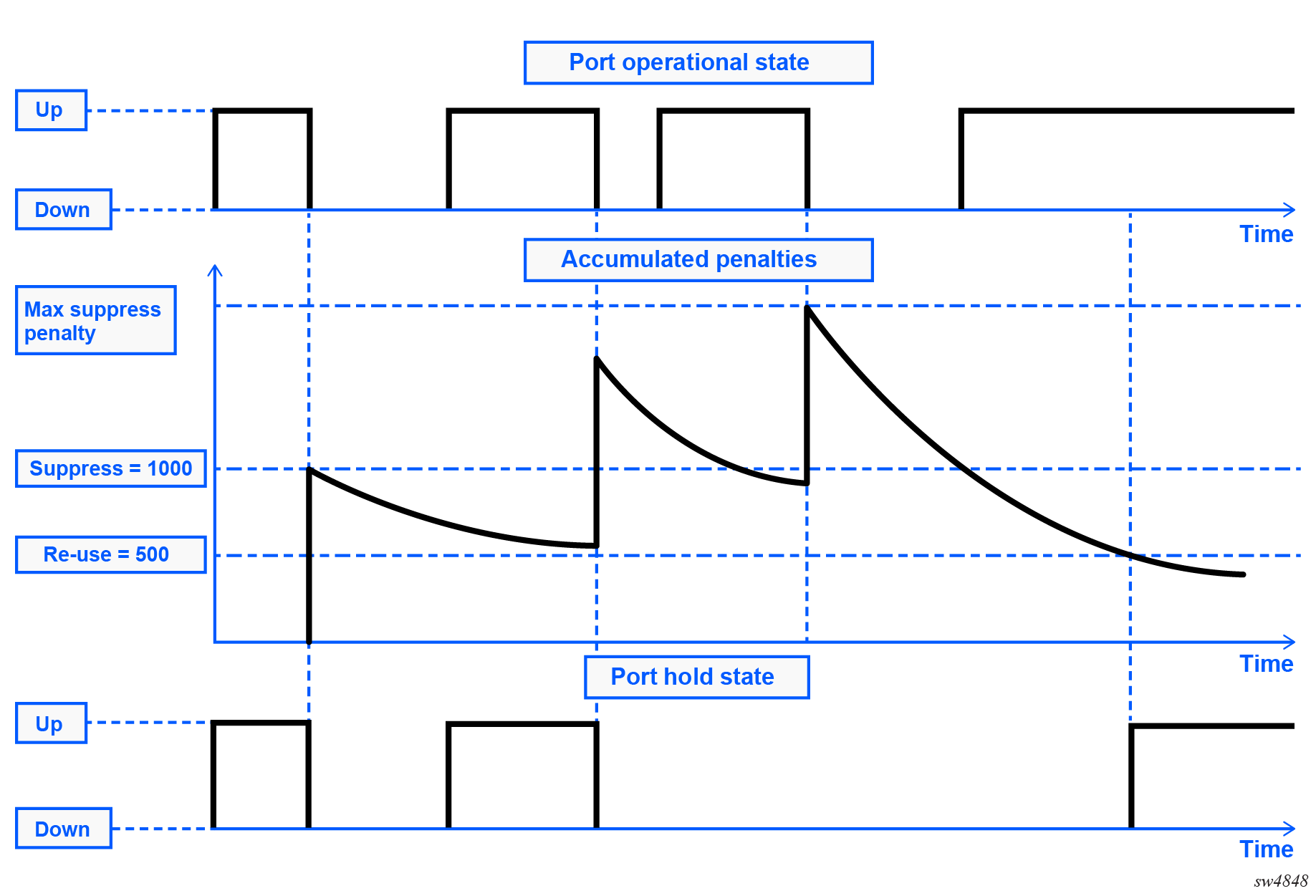
In this example, when the operational state of a port goes from up to down, EPD assigns a penalty value to the port of 1000 points. The 1000 point penalty value is not configurable. Over a period of time (the configured half-life decay time, default 5 seconds), the exponential decay calculated by the equation in Exponential decay formula gradually reduces the accumulated penalties, as long as the port's operational state does not change, or it changes from down to up.
If the port again transitions from up to down, the port is assigned another 1000-point
penalty. The penalty values are cumulative, so if a port had 250 penalty points when it
went operationally down, the additional penalty gives it a total of 1,250 points. If the
accumulated penalties for a port reach a configured threshold (the suppress-threshold,
default 2000 points), EPD suppresses the port state, preventing it from being used by
the upper-layer routing protocols. While the port is suppressed, the
exponential-port-dampening oper-state for the port is
active. In order for the suppressed state to be removed for the
port, its accumulated penalties must drop below a threshold (the configured
reuse-threshold, default 1000 points). When the penalties drop below the
reuse-threshold, the hold state is removed for the port, making it available to the
upper-layer protocols.
You can configure the following parameters for EPD:
-
admin-state
Enables EPD for the port.
-
half-life
Sets the half-life decay period for penalties assigned to the port. This is the duration of time that must pass before penalties decay to one-half the initial amount. Each second, the system reduces the accumulated penalties for the port using the equation shown in Exponential decay formula.
-
max-suppress-time
Following a port-up event, sets the maximum amount of time that a port can remain in the suppressed state before its accumulated penalties decay to the reuse-threshold value; default 20 seconds.
-
reuse-threshold
Sets the number of penalty points for a port in the suppressed state to no longer be suppressed. If a port is in the suppressed state and its accumulated penalties decays below this threshold, the port-up state is not suppressed anymore; default 1000 points.
-
suppress-threshold
Sets the number of penalty points a port can accumulate from port-down events before it is placed in the suppressed state. When accumulated penalties from port-down events exceed this threshold, the port-up state is suppressed until the penalties drop below the reuse-threshold; default 2000 points
When both the interface hold-timer feature and EPD are configured for an interface, both hold-time up timer and EPD suppression must be expired before the port is made available to the upper-layer routing protocols.
EPD is supported for Ethernet interfaces only, excluding those that are part of a LAG. You cannot configure EPD for an interface in breakout mode or for the management port.
EPD does not affect the port LED color, which reflects the physical status of the port; that is, the port LED is green when the hold-time up timer is running, or the timer has expired and EPD suppression is in operation, and solid amber when the hold-time down timer is running.