Serial transport over raw sockets
Serial transport over raw sockets provides the capability of transporting serial data, in the form of characters, over an IP transport service within a Layer 3 IP/MPLS service (IES or VPRN). A raw socket allows direct sending and receiving of IP packets without any protocol-specific transport layer formatting. For information about raw socket IP transport services, see the 7705 SAR Gen 2 Services Overview Guide.
This feature provides the functionality for a local host to listen to and open raw socket sessions from remote hosts, and for a remote host to initiate and open raw socket sessions to local hosts. The local and remote host functions support TCP or UDP sessions (but not both concurrently) over the IP transport service.
Raw sockets are supported on RS-232 ports on the 4-port RS-232 and 4-port C37.94 interface card.
-
RS-232 serial data can be carried over Cpipes or over raw sockets using IP transport. To use Cpipes, the RS-232 port must be configured with a channel ID. To use raw sockets, the RS-232 port must be configured with a socket ID.
-
The node supports a mix of Cpipes and raw socket serial links on the same card.
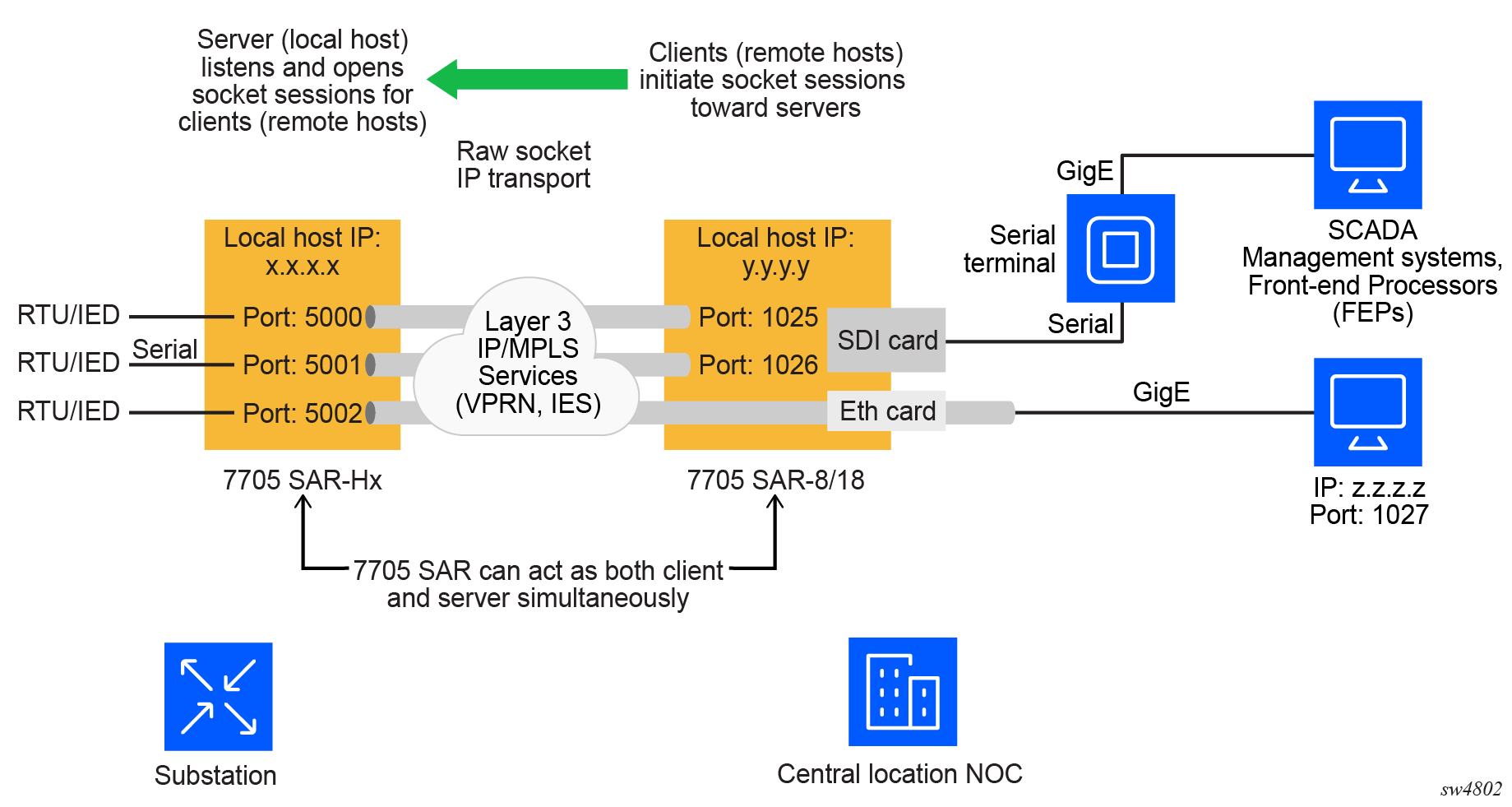
Serial transport over raw socket application on the 7705 SAR-Hx shows an example of a raw socket application, where serial data is transferred between RTUs and the utility SCADA management system using an IP transport service across a Layer 3 service (IES or VPRN), that includes 7705 SAR-Hx.
A raw socket local host (acting as a server) at the 7705 SAR-Hx substation listens to TCP sessions that originate at the 7705 SAR-8 Shelf V2/7705 SAR-18 central location network operations center (NOC). The 7705 SAR-8 Shelf V2/7705 SAR-18 at the NOC is connected to two front-end processors (FEPs), one via a serial port and another via an Ethernet port. The serial port on the 7705 SAR-8 Shelf V2/7705 SAR-18 is configured as a remote host (acting as a client) that initiates TCP/UDP sessions toward the RTU at the 7705 SAR-Hx substation when traffic is received from the FEP over the serial port. These TCP/UDP sessions are transported over the IP/MPLS network using IP transport service over an IES or VPRN service. The serial data that is transported over the TCP/UDP session and received at the 7705 SAR-Hx is sent over the serial link toward the RTU. TCP/UDP sessions received from the FEP over the Ethernet port are transported over an IES or VPRN service (that is, there is no need for serial remote host configuration in this case).
Multiple FEPs can poll a single RTU. If multiple sessions attempt to transmit serial data on the serial port simultaneously, the 7705 SAR Gen 2 queues packets per session and ensures that all data for one session is sent out before processing another session’s data, ensuring that sessions do not overlap one another.
configure service ies ip-transport local-host
configure service vprn ip-transport local-host
configure service ies ip-transport remote-host
configure service vprn ip-transport remote-host