
Control plane behavior
From a control-plane perspective, an egress leaf working in Anycast MH mode (such as Leaf1 and Leaf2 in EVPN Anycast MH) for a given ES works as follows:
- AD per-EVI routes for Anycast MH ESes are suppressed based on the Anycast MH mode
configuration.
- AD per-EVI routes are suppressed only for MAC-VRFs with VXLAN encapsulation.
- This applies to nodes sharing ESs by mac-vrfs with vxlan and mpls encap.
- AD per-ES routes for Anycast MH ESes are advertised with the A=1
flag in ESI label extended community (as defined in draft-rabnag-bess-evpn-anycast-aliasing).
- The anycast-multi-homing flag indicates to remote NVEs
that EVPN MAC/IP Advertisement routes with matching Ethernet Segment
Identifier are resolved only by A-D per ES routes for the ES. This flag
signals to the ingress leaf that no A-D per EVI routes are advertised for
the Ethernet Segment. The A flag is bit 2 in the Flags field of the ESI
label extended community.
Figure 1. ESI label extended community 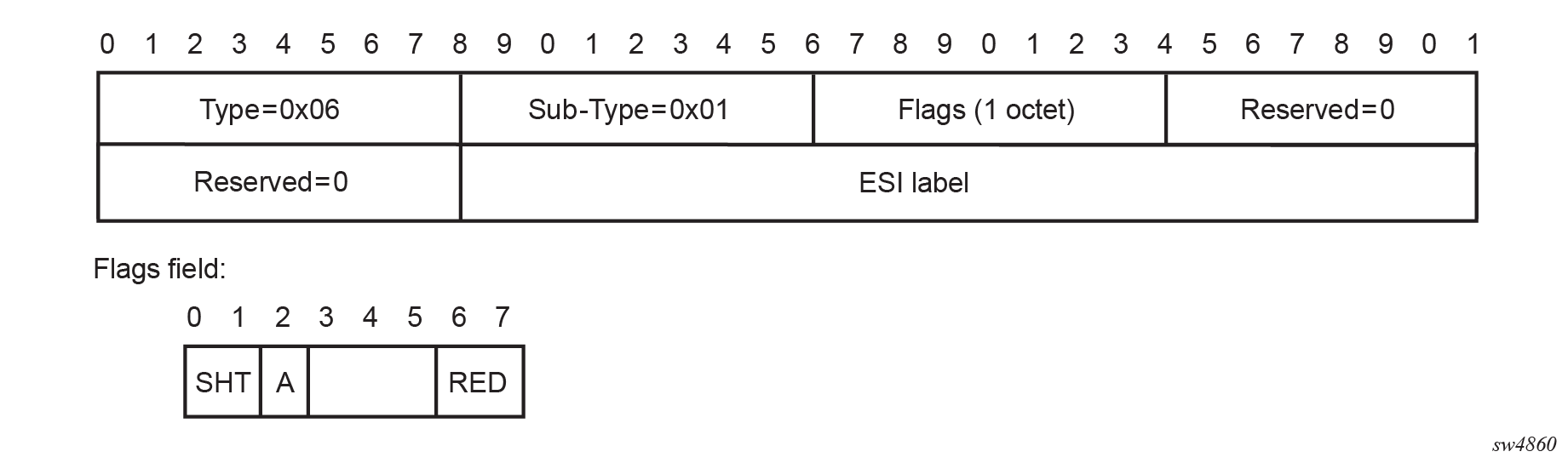
- The BGP tunnel-encapsulation attribute ( per draft-rabnag-bess-evpn-anycast-aliasing) carries the Anycast
VTEP; specifically, it is encoded in the BGP Tunnel Encapsulation Attribute
Tunnel Egress Endpoint Sub-TLV (code point 6) [RFC9012]. The Tunnel Egress Endpoint Sub-TLV
Value Field is shown below.
Figure 2. Tunnel egress endpoint Sub-TLV 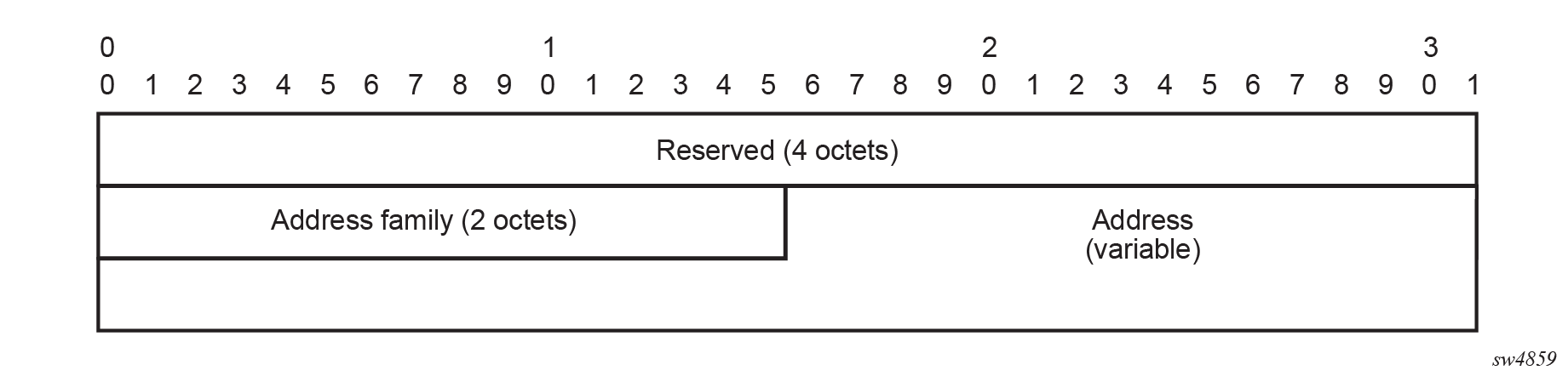
- The anycast-multi-homing flag indicates to remote NVEs
that EVPN MAC/IP Advertisement routes with matching Ethernet Segment
Identifier are resolved only by A-D per ES routes for the ES. This flag
signals to the ingress leaf that no A-D per EVI routes are advertised for
the Ethernet Segment. The A flag is bit 2 in the Flags field of the ESI
label extended community.
- MAC/IP routes for MACs learned on the ES working in Anycast MH mode are advertised
with ESI. The next-hop is either the regular
system0.0IPv4 address or the one determined by network-instance[=mac-vrf].protocols.bgp-evpn.bgp-instance.routes.bridge-table.next-hop <ip-address>