
Nokia multi-access broadband CUPS solution
The Nokia cloud-based converged broadband CUPS architecture enhances the triple play service delivery architecture (TPSDA). The Nokia MAG-c implements both the fixed access and fixed wireless access (FWA) CP functions. The Nokia SR OS-based MAG-u implements both the fixed access and FWA UP functions.
Evolution of the BNG
The Nokia SR OS TPSDA originated as a BNG providing traditional broadband services such as high-speed Internet (HSI), voice over IP (VoIP), IPTV, wholesale/retail, and network address translation (NAT).
Over the years, the broadband access demand evolved beyond traditional wireline access and into wireless access. The Nokia BNG evolved to support the Wi-Fi gateway function, the FWA function, and the hybrid access gateway (HAG) function.
- Virtualized Service Routers (VSRs)
- physical Service Routers (SRs)
- a combination of both
Cloud-based MAG-c architecture
The following figure shows the overall Nokia multi-access CUPS architecture, with the following virtualized network functions (VNFs) of the MAG-c:
- operation and maintenance virtual machine (OAM-VM) – management interface for the MAG-c configuration
- database virtual machine (DB-VM) – common storage for all subscriber session state
- session management virtual machine (SM-VM) – subscriber management function and processing
- load balancing virtual machine (LB-VM) – load distribution to various SM-VMs
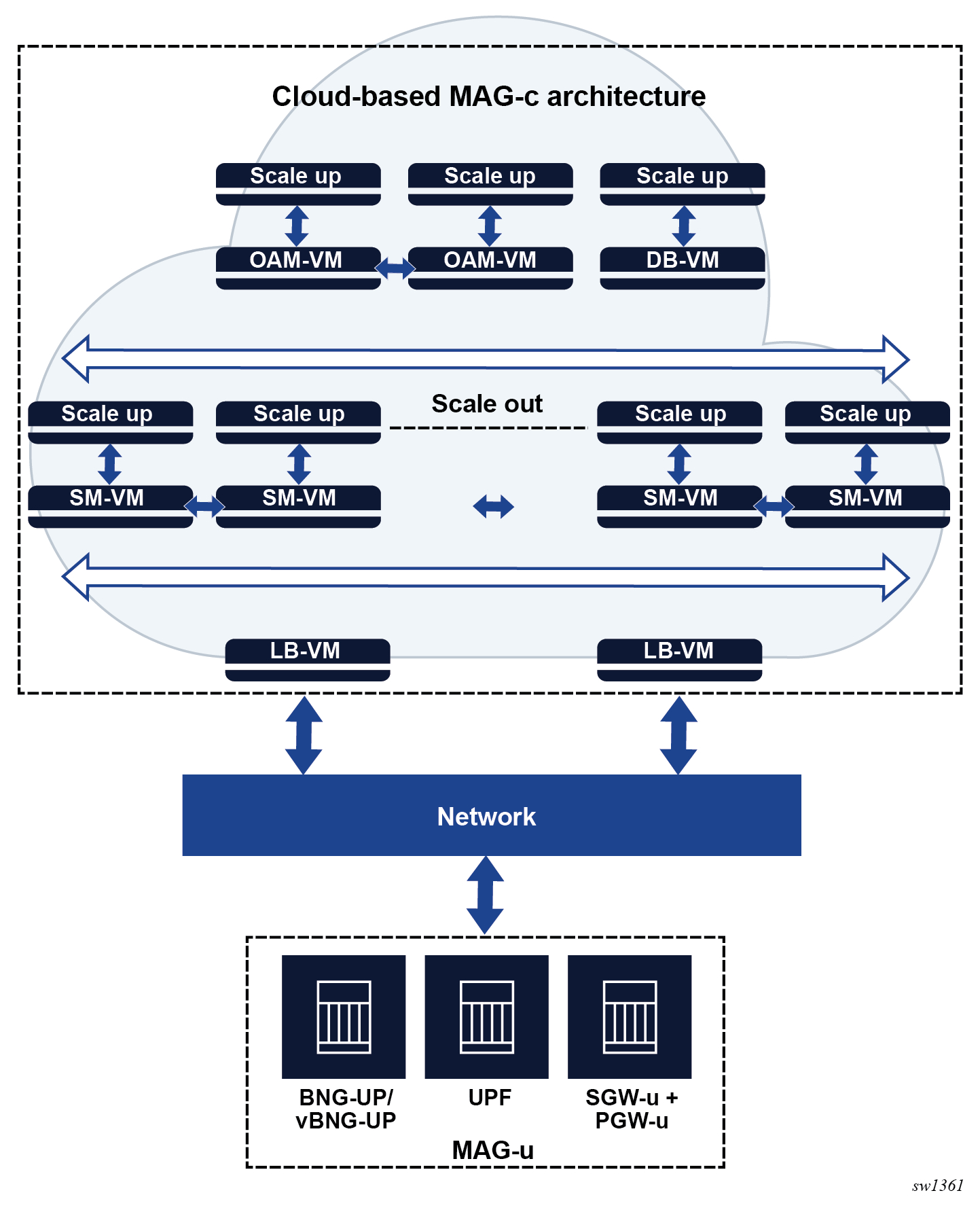
See the MAG-c Installation Guide for more information about the MAG-c architecture and installation.
MAG-u overview
The Nokia SR OS-based MAG user plane (MAG-u) acts as the UP for the MAG-c. Both the VSR and the SR platforms support the MAG-u functions. The Nokia MAG-u supports the following functions when acting as a UP:
- BNG UP function
- 5G UP function (UPF) for 5G FWA
- combined SGW-U + PGW-U for 4G FWA
- broadband subscriber management services, IP over Ethernet (IPoE), point-to-point protocol over Ethernet (PPPoE), LAC, and LNS
- FWA
- NAT
- multicast
- public Wi-Fi
- HAG