
Nokia value propositions
A CUPS architecture disaggregates session management between the CP and the UP. The CUPS architecture provides the advantage of independent scaling and independent life cycle management.
Simplifying operation and maintenance
Because the disaggregation of a BNG into a CP and UP introduces more network elements to manage, the Nokia converged broadband CUPS solution greatly emphasizes management simplification:
- The management interface to operate, maintain, and manage the entire CUPS solution is simple, compact, and controlled.
- Grouping functions help to process subscriber sessions efficiently and responsively.
- The solution is extensible to support additional convergence use cases in the future.
A traditional BNG is a single unit that contains both the CP and UP. When either the subscriber or the bandwidth scale grows, more BNGs are deployed to accommodate the growth. Even though, for example, bandwidth growth only requires more UP resources, the additional BNG provides additional unnecessary CP resources. In addition, because the BNGs are individually managed, any new service offering requires configuration changes to each individual BNG.
The Nokia MAG-c provides a centralized location for managing subscriber authentication, policies, and accounting settings. The solution requires minimal provisioning touches. Most configurations required on the Nokia MAG-u are performed once only during commissioning. In production, the Nokia CUPS solution sets up subscriber forwarding with zero touch.
- load balance new subscriber sessions among the MAG-u nodes to ensure even distribution
- determine if failing over to a new MAG-u is necessary during a failure event, depending on the remaining adequate resources
The following figure shows the functional blocks within a MAG-c and how the virtualized network function (VNF) components within the MAG-c are grouped. The grouping of the VNF components into specific functional blocks is deliberate and ensures the most efficient subscriber session processing, simplifying both operations and management.
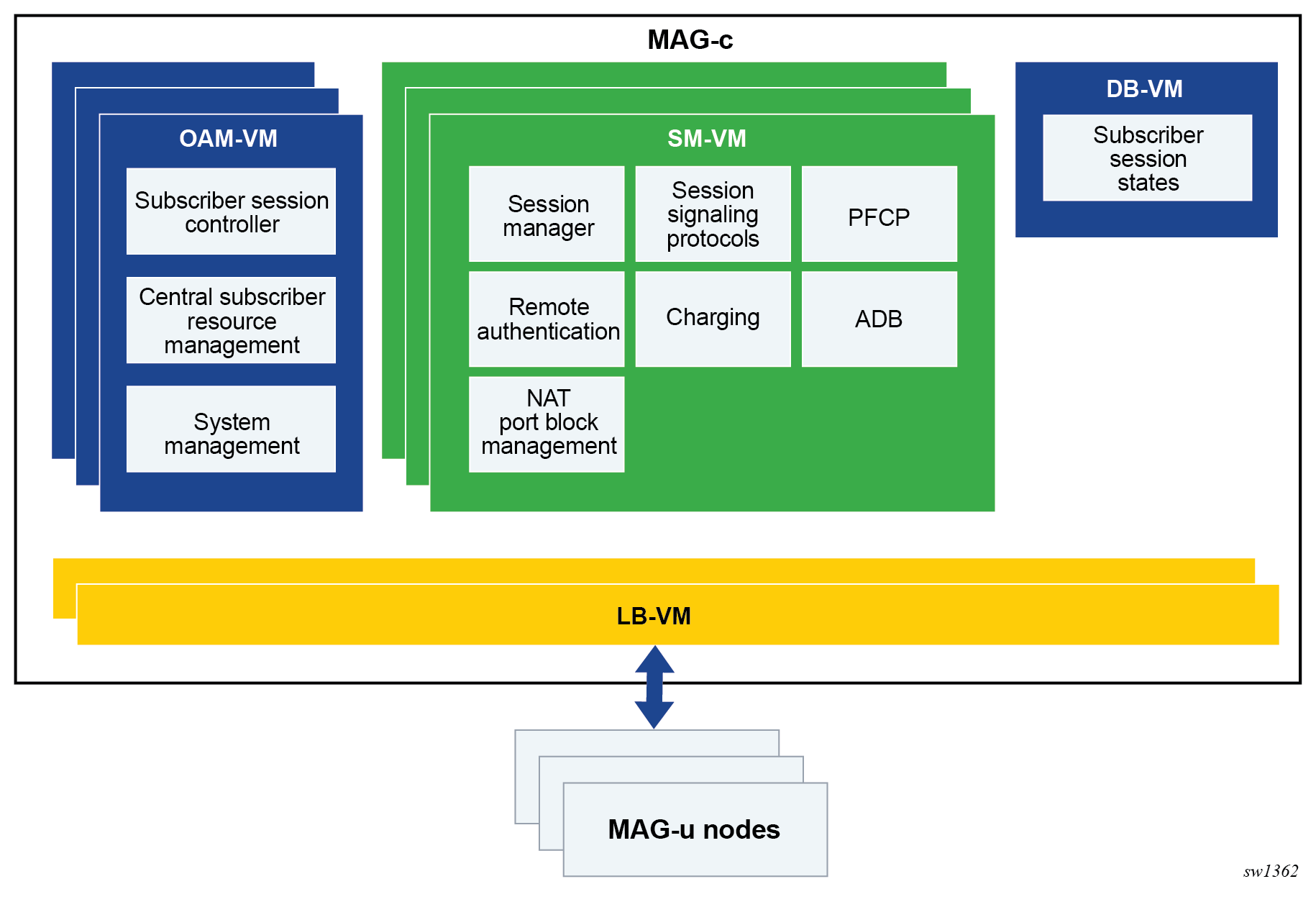
- The central subscriber resources management provides IP pool address management.
- The subscriber session controller provides operations on the session information of active subscribers and enforces common policies such as limits on the number of active subscribers.
The grouping of the common subscriber management functions within the SM-VM allows for efficient processing of subscriber session setup, modification, and tear down.
- The session manager is responsible for managing IPoE, PPPoE, layer 2 tunneling protocol access concentrator (L2TP LAC), and FWA sessions.
- The session signaling protocols functional block includes dynamic host configuration protocol (DHCP), DHCP for IPv6 (DHCPv6), stateless address auto-configuration (SLAAC), GPRS tunneling protocol (GTP), PPPoE discovery, link control protocol (LCP), network control protocol (NCP), password authentication protocol (PAP), and challenge handshake authentication protocol (CHAP).
The LB-VM solely performs the balancing of control packets and can automatically accommodate the scaling in and out of the OAM-VM and SM-VM independently.
The DB-VM stores the subscriber session state sent by the SM-VMs. If one or more SM-VMs fail, the DB-VM provides the full subscriber session state to the backup SM-VMs.
The MAG-c architecture allows flexibility for accommodating future needs. New functional blocks can be added to the SM-VM to support additional broadband use cases and to the OAM-VM for further management improvements.
See the MAG-c Control Plane Function Guide for more information about the MAG-c.
Single northbound IP interface for external systems
Traditionally, scaling up the BNG also requires the AAA servers to handle more interfaces to the BNGs. Continual investment in the IT network infrastructure is required to accommodate new connectivity between the BNGs and the AAA servers, the external DHCP servers, and the policy servers.
The Nokia MAG-c solution addresses this problem by presenting a single northbound interface to the AAA servers and the policy servers in scale-up or -down scenarios. This reduces the IT infrastructure for back-end systems. One source IP address on the MAG-c represents the entire converged network. The MAG-c also provides a single IP address for requests coming from a remote authentication system; for example, for unsolicited authorization change requests such as the RADIUS Change of Authorization (CoA) messages.
See the MAG-c Control Plane Function Guide for more information about authentication.
Centralized resource management
On traditional BNGs, the IP address pools need to be defined and pre-allocated to individual BNGs. Subscriber growth can complicate the IP address pool redistribution, especially when the availability of IPv4 public addresses is limited.
The Nokia MAG-c solution tackles this problem by providing a centralized subscriber resource management platform. Resources such as IP addresses are claimed on an on-demand basis using the on-demand subnet allocation (ODSA) address assignment system. ODSA eliminates the operational burden of pre-allocating dedicated pools to the MAG-u nodes. ODSA is applicable for all pool address management including DHCPv4, PPPoE IPv4 addresses, DHCPv6, and the SLAAC prefix pool. Because IP subnets are not pre-allocated to individual MAG-u nodes, there are no idle subnets in the MAG-u nodes. Addresses and prefixes are dynamically allocated to the MAG-u nodes that require them most, which minimizes the waste of IP addresses and prefixes.
ODSA automatically accounts for MAG-u resiliency and eliminates any address pool pre-planning.
See the MAG-c Control Plane Function Guide for more information about address assignment.
Centralized resources for NAT
Traditionally, IPv4 public address pools are pre-allocated per BNG. The MAG-c is a centralized management point and assigns public address subnets to MAG-u nodes in real time, ensuring no waste of IPv4 public addresses. The MAG-c uses the ODSA system for allocating these public address subnets.
Public address subnet assignment automatically accounts for MAG-u resiliency and eliminates any NAT public pool pre-planning.
NAT logging is centralized and integrated into subscriber accounting where the MAG-c interfaces with the RADIUS accounting back-end systems.
See the 7750 SR and VSR BNG CUPS User Plane Function Guide and the MAG-c Control Plane Function Guide for more information about carrier-grade NAT (CGNAT).
Flexible authentication and authorization flows
- locally provisioned authentication and authorization policies
- mobile-based authentication such as home subscriber server (HSS) or unified data management (UDM)
- wireline-based authentication such as RADIUS
- a combination of the preceding options
- local authentication policies
- remote authentication AAA servers with selection based on the use case
- RADIUS-based and SBI-based AAA servers
- grouping and identifying subscribers by authentication option that is, subscribers that require wireline authentication versus wireless authentication
- multiple authentication sequences for a single subscriber session (for use cases such as wholesale and retail)
The following are examples of the requirements for policy control:
- ability to retrieve subscriber policies locally or remotely
- AAA servers and policy and charging rules function (PCF/CHF) servers for the retrieval of remote policies.
- concatenation of various policy rules retrieved from different policy servers to form a subscriber policy
The MAG-c provides an authentication database (ADB) for full flexibility in authentication and policy enforcement. The ADB accommodates any complex sequencing of authentication and policy control and provides the ability to define a flow for a single subscriber or a group of subscribers. Multiple ADBs can be accessed in sequence to accommodate multiple authentication and authorization sources.
See the MAG-c Control Plane Function Guide for more information about the ADB.
Independent life cycle management and scaling of the MAG-c and MAG-u
Traditionally, a BNG is offered as a single chassis, where the CP and UP are bundled together as a single unit. When the CP or UP capacity is reached, there are few options except to install a new chassis or new line cards.
The CP on an integrated BNG (CPM) can be a limiting factor on subscriber scale. The CPM is often required to process and generate many control packets, such as authentication messages, accounting records, log events, and keep-a-live signaling. In addition, a MAG that processes FWA subscribers, hybrid access subscribers, and Wi-Fi subscribers requires additional CP processing power for control messages signaling.
- The MAG-u scales up without the confinement of a chassis.
- All MAG-u platforms can be managed by a single MAG-c.
- Service providers can select the MAG-u platform that best serves a particular use case.
- The MAG-c can manage any mix of MAG-u platforms.
See the MAG-c Installation Guide for more information about MAG-c scaling.
Dual role of the MAG-u
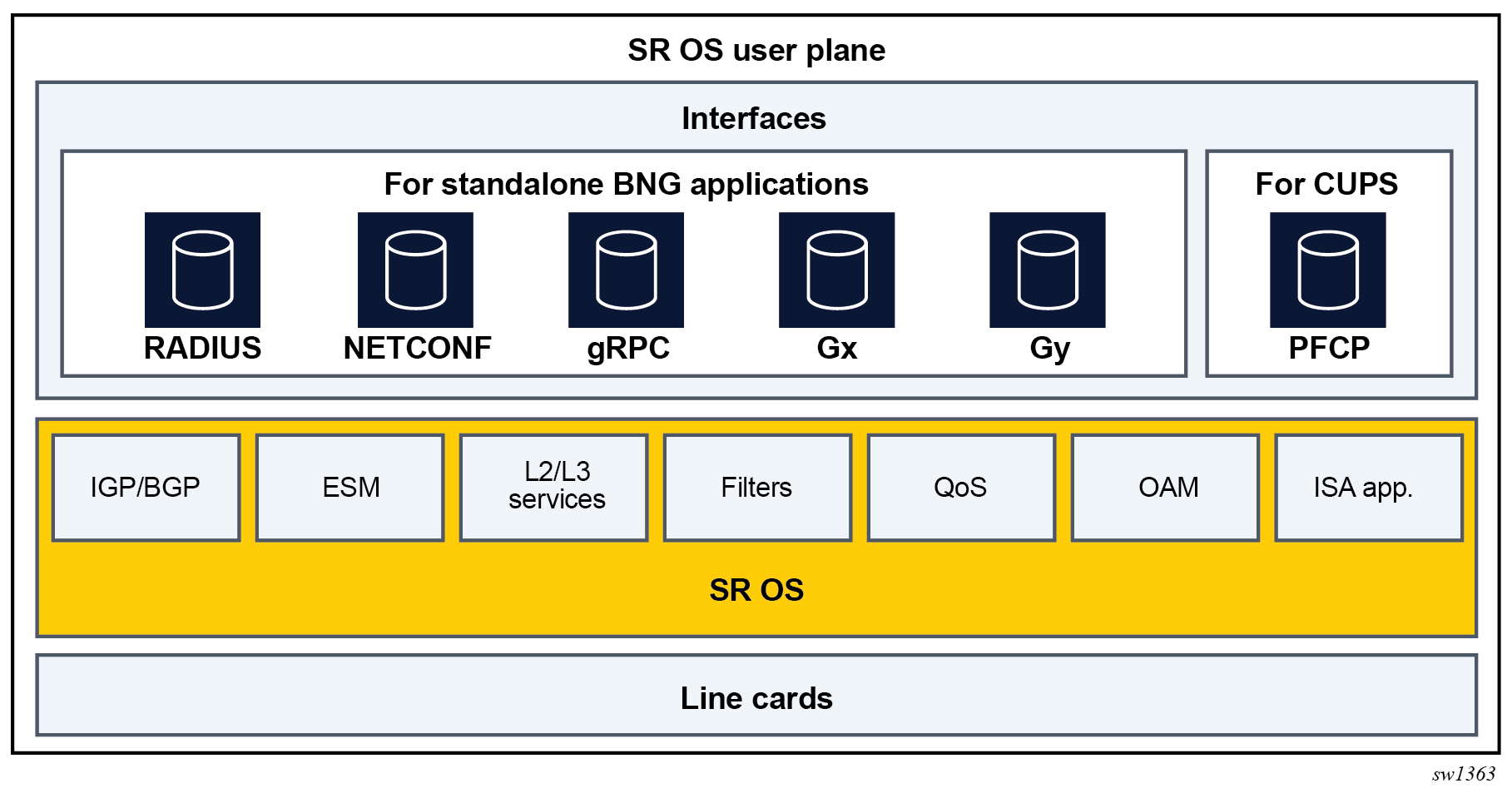
All SR OS platforms can simultaneously act as a MAG-u and as a standalone BNG. In standalone BNG mode, all SR OS TPSDA features are supported including ESM, wireless local area network - gateway (WLAN-GW), FWA, HAG, and virtual routed gateway (vRGW). In other words, any MAG-u in the production network can serve as a MAG-u when a PFCP SCi interface is added and as a standalone BNG. When a MAG-u takes on the additional UP function, the existing BNG services in production are not impacted.
To enable a platform to support the MAG-u function, minimal commissioning configuration is required. The MAG-u typically requires no additional configuration after it is commissioned.
The following figure shows the common broadband interfaces supported on the MAG-u and the key applications supported on the SR OS. The MAG-u can serve as a standalone BNG supporting all the classic management interfaces including RADIUS, network configuration protocol (NETCONF), gRPC remote procedure call (gRPC), Gx, and Gy. At the same time, the MAG-u can support PFCP for the MAG-c applications.
See the 7750 SR and VSR BNG CUPS User Plane Function Guide for more information about the MAG-u.
Nokia MAG-c broadband CUPS use cases
- IPoE dual stack
- PPPoE dual stack
- L2TP LAC
- CGNAT
- data-trigger subscribers
- static IP subscribers
- FWA
MAG-c CUPS use cases for fixed wireline wireless convergence
The MAG-c CUPS solution supports the following converged use cases:
- 4G FWA
- 4G and 5G non-standalone (NSA) option 3 FWA
- 5G standalone (SA) FWA
- BNG-UP
- combined PGW-U + SGW-U
- 5G UPF
The multi-functional MAG-c CP and MAG-u UP are possible because both broadband wireline and mobile wireless access use the standard defined 3GPP PFCP protocol for the SCi interface. 3GPP specifies the use of PFCP for the 4G and 5G core while BBF specifies the use of PFCP for wireline and converged access CUPS architectures.
High availability support
The Nokia multi-access broadband CUPS solution supports both CP resiliency and UP resiliency.
MAG-c resiliency architecture
The MAG-c supports geo-redundancy, which enables minimal service impact during CP software upgrades. The CP also supports intra-VNF resiliency.
See the MAG-c Control Plane Function Guide for more information about the CP geo-redundancy installation.
UP resiliency architecture
- link failure
- line card failure
- chassis failure
See the MAG-c Control Plane Function Guide for more information about UP resiliency.
UP headless mode
The Nokia CUPS solution accounts for failure conditions where the MAG-c and MAG-u are only briefly disconnected. In this case, if the MAG-u loses its connectivity to the MAG-c and becomes headless, during the headless period the MAG-u continues to service all connected sessions. After restoring the path between the MAG-c and MAG-u, the MAG-c ensures that all subscriber states are synchronized.
See the 7750 SR and VSR BNG CUPS User Plane Function Guide, the MAG-c Control Plane Function Guide, and the MAG-c PFCP Interface Description Guide for more information about the headless mode.
Migration to CUPS
All MAG-u nodes are SR OS platforms that provide the full SR OS feature sets, including all TPSDA features.
Any SR OS BNG in a production network can be configured to take on the role of a MAG-c-controlled MAG-u node, on a per-capture-SAP basis. All existing configurations continue to function even when taking on the MAG-u role. For example, it is possible to leave all existing customers on their respective service access points (SAPs) and dedicate some new SAPs to host new CUPS subscribers.
This flexibility allows service providers to achieve the following subscriber-management goals:
- selectively migrate subscribers from an existing SAP to a new CUPS-based SAP
- selectively migrate CUPS subscribers back to their original SAPs
- indefinitely maintain existing BNG subscribers on their existing SAPs