
BGP Multipath
This chapter provides information about BGP Multipath.
Topics in this chapter include:
Applicability
The CLI in the latest update of this chapter corresponds to SR Linux Release 26.7.3.
Overview
When BGP multipath is enabled, traffic can be forwarded to an IP prefix destination over multiple BGP paths that are considered equal by the BGP decision process. BGP multipath is supported in the default network instance and in IP-VRFs, both for IBGP and EBGP. The multipath command specifies the maximum number of EBGP and IBGP paths that each BGP RIB can submit to the route table for an IP prefix.
As described in chapter Separate BGP RIBs for Labeled Routes, labeled routes and unlabeled routes do not mix.
BGP multipath can be configured per address family in the network-instance <..> protocols bgp afi-safi <..> context. Following parameters are possible:
--{ + candidate shared default }--[ network-instance default protocols bgp afi-safi ipv4-unicast ]--
A:admin@PE-5# multipath ?
usage: multipath

Enter the multipath context

Options related to BGP multipath

Local commands:
  allow-multiple-as*
                    When set to true, BGP is allowed to build a multipath set using BGP routes with different neighbor AS (most recent AS in the AS_PATH)
  ebgp              Enter the ebgp context
  ibgp              Enter the ibgp context
The allow-multiple-as parameter is by default true. When set to false, only paths with the same neighbor AS are used.
--{ + candidate shared default }--[ network-instance default protocols bgp afi-safi ipv4-unicast multipath ]--
A:admin@PE-5# allow-multiple-as ?
usage: allow-multiple-as <true|false>

When set to true, BGP is allowed to build a multipath set using BGP routes with different neighbor AS (most recent AS in the AS_PATH)

When set to false, BGP is only allowed to use non-best paths for ECMP if they meet the multipath criteria and they have the same neighbor AS as the best path

Positional arguments:
  value             [true|false, default true]
In the ebgp and the ibgp context, the maximum number of paths can be configured. It is also possible to configure weighted ECMP, but that is beyond the scope of this chapter.
--{ + candidate shared default }--[ network-instance default protocols bgp afi-safi ipv4-unicast multipath ]--
A:admin@PE-5# ebgp ?
usage: ebgp

Enter the ebgp context

Multipath configuration options that apply when the best path for the prefix was received from an EBGP peer

Local commands:
  maximum-paths*    The maximum number of BGP ECMP next-hops for BGP routes with an NLRI belonging to the address family of this configuration context
  weighted-ecmp     Enter the weighted-ecmp context
--{ + candidate shared default }--[ network-instance default protocols bgp afi-safi ipv4-unicast multipath ebgp ]--
A:admin@PE-5# maximum-paths <value:1> ?
usage: maximum-paths <1..256>

The maximum number of BGP ECMP next-hops for BGP routes with an NLRI belonging to the address family of this configuration context

Positional arguments:
  value             [number, range 1..256, default 1]
Configuration
The examples in this section show the multipath BGP configuration in the default network instance. For BGP multipath in an IP-VRF, the configuration is similar.
Example topology shows the example configuration with the used IP addresses. PE-5 has EBGP sessions with CEs in different autonomous systems (ASs) and IBGP sessions with PE-6, PE-7, PE-8, and PE-9.
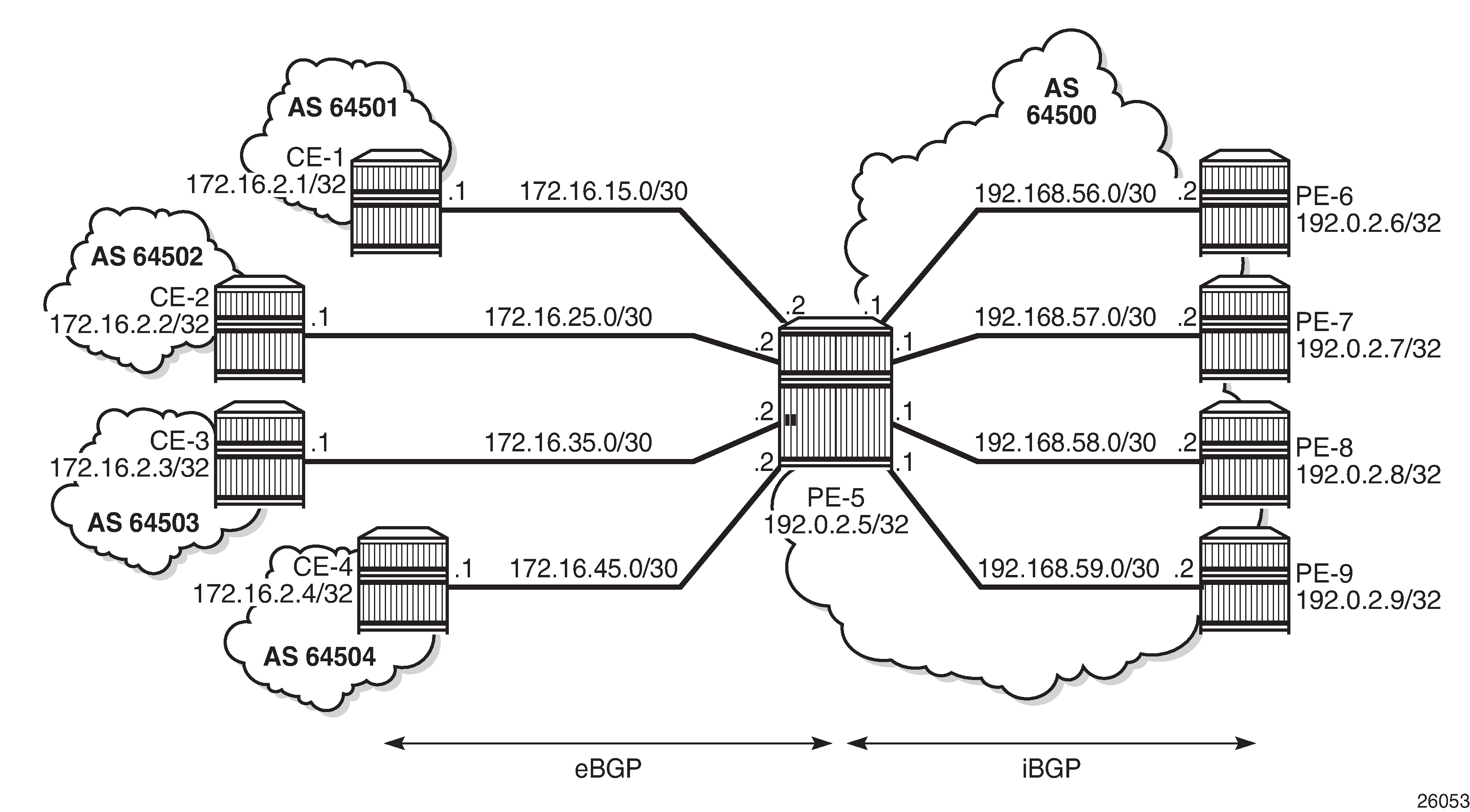
The initial configuration includes:
-
Interfaces and subinterfaces
-
Default network instance on all nodes
-
IS-IS in AS 64500
-
LDP in AS 64500
-
BGP on all nodes (EBGP between CEs and PE-5; IBGP between PEs)
The BGP configuration on CE-1 is as follows:
# on CE-1:
enter candidate
    network-instance default {
        protocols {
            bgp {
                admin-state enable
                autonomous-system 64501    # different on different CEs
                router-id 172.16.2.1
                afi-safi ipv4-unicast {
                    admin-state enable
                }
                group grp-EBGP {
                    admin-state enable
                    peer-as 64500
                    export-policy [
                        rp-export-bgp
                    ]
                }
                neighbor 172.16.15.2 {
                    peer-group grp-EBGP
                }
            }
The BGP configuration on the other nodes that advertise routes to PE-5 is similar.
The BGP configuration on PE-5 is as follows:
# on PE-5:
enter candidate
    network-instance default {
        protocols {
            bgp {
                admin-state enable
                autonomous-system 64500
                router-id 192.0.2.5
                afi-safi ipv4-unicast {
                    admin-state enable
                }
                group grp-IBGP {
                    admin-state enable
                    peer-as 64500
                }
                group grp-EBGP {
                    admin-state enable
                    import-policy [
                        rp-import-ebgp
                    ]
                }
                neighbor 172.16.15.1 {
                    peer-group grp-EBGP
                    peer-as 64501
                }
                neighbor 172.16.25.1 {
                    peer-group grp-EBGP
                    peer-as 64502
                }
                neighbor 172.16.35.1 {
                    peer-group grp-EBGP
                    peer-as 64503
                }
                neighbor 172.16.45.1 {
                    peer-group grp-EBGP
                    peer-as 64504
                }
                neighbor 192.0.2.6 {
                    peer-group grp-IBGP
                }
                neighbor 192.0.2.7 {
                    peer-group grp-IBGP
                }
                neighbor 192.0.2.8 {
                    peer-group grp-IBGP
                }
                neighbor 192.0.2.9 {
                    peer-group grp-IBGP
                }
            }
The following examples are configured and verified:
BGP multipath with different EBGP and IBGP path limits
On PE-5, BGP multipath is configured for the IPv4-unicast address family, as follows:
# on PE-5:
enter candidate
    network-instance default {
        protocols {
            bgp {
                afi-safi ipv4-unicast {
                    multipath {
                        # allow-multiple-as true    # default: true
                        ebgp {
                            maximum-paths 2
                        }
                        ibgp {
                            maximum-paths 3
                        }
                    }
                }
            }
With this configuration, there can be two EBGP routes for the same prefix and three IBGP routes for the same prefix.
In the following example, all four EBGP neighbors advertise prefix 3.1.0.0/32 to PE-5 and all four IBGP neighbors advertise prefix 3.2.0.0/32 to PE-5. PE-5 receives four EBGP routes for prefix 3.1.0.0/32, but only two are added to the common IP route table, as shown in BGP multipath with EBGP limit 2.
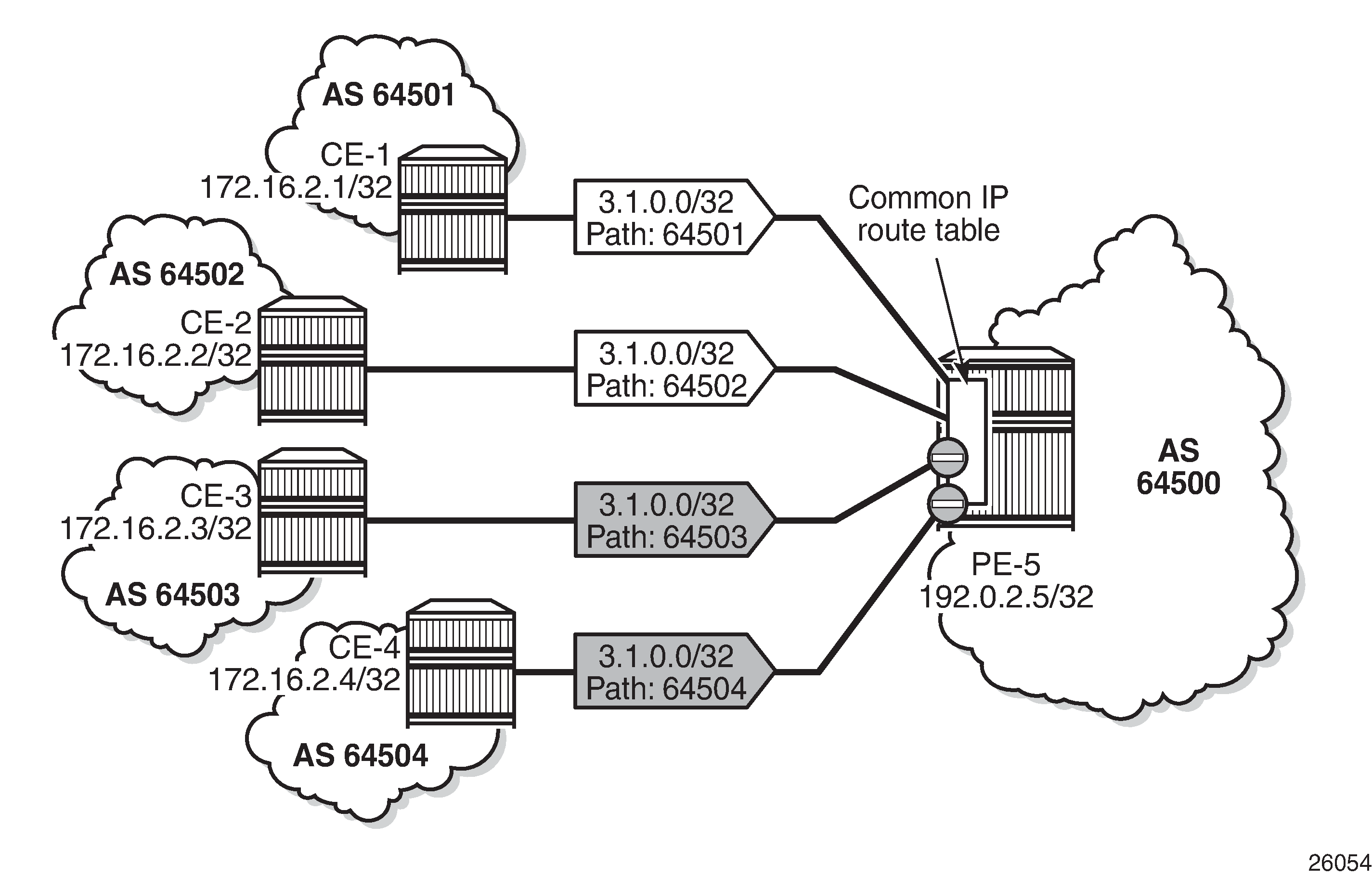
The first two of the following BGP routes for prefix 3.1.0.0/32 are used on PE-5:
--{ + running }--[  ]--
A:admin@PE-5# show / network-instance default protocols bgp routes ipv4 prefix 3.1.0.0/32
------------------------------------------------------------------------------------------
Show report for the BGP routes to network "3.1.0.0/32" network-instance  "default"
------------------------------------------------------------------------------------------
Network: 3.1.0.0/32
Received Paths: 4
  Path 1: <Best,Valid,Used,>
    Route source    : neighbor 172.16.15.1
    Route Preference: MED is -, No LocalPref
    BGP next-hop    : 172.16.15.1
    Path            :  i [64501]
    Communities     : 64500:5
  Path 2: <Best,Valid,Used,>
    Route source    : neighbor 172.16.25.1
    Route Preference: MED is -, No LocalPref
    BGP next-hop    : 172.16.25.1
    Path            :  i [64502]
    Communities     : 64500:5
  Path 3: <Best,Valid,>
    Route source    : neighbor 172.16.35.1
    Route Preference: MED is -, No LocalPref
    BGP next-hop    : 172.16.35.1
    Path            :  i [64503]
    Communities     : 64500:5
  Path 4: <Best,Valid,>
    Route source    : neighbor 172.16.45.1
    Route Preference: MED is -, No LocalPref
    BGP next-hop    : 172.16.45.1
    Path            :  i [64504]
    Communities     : 64500:5
Path 2 was advertised to:
[ 192.0.2.6, 192.0.2.7, 192.0.2.8, 192.0.2.9 ]
-----------------------------------------------------------------------------------------
The four IBGP neighbors of PE-5 advertise prefix 3.2.0.0/32 to PE-5. BGP multipath has a limit of three for IBGP routes. Consequently, three BGP routes are added to the common IP route table and to the FIB, as shown in BGP multipath with IBGP limit 3.
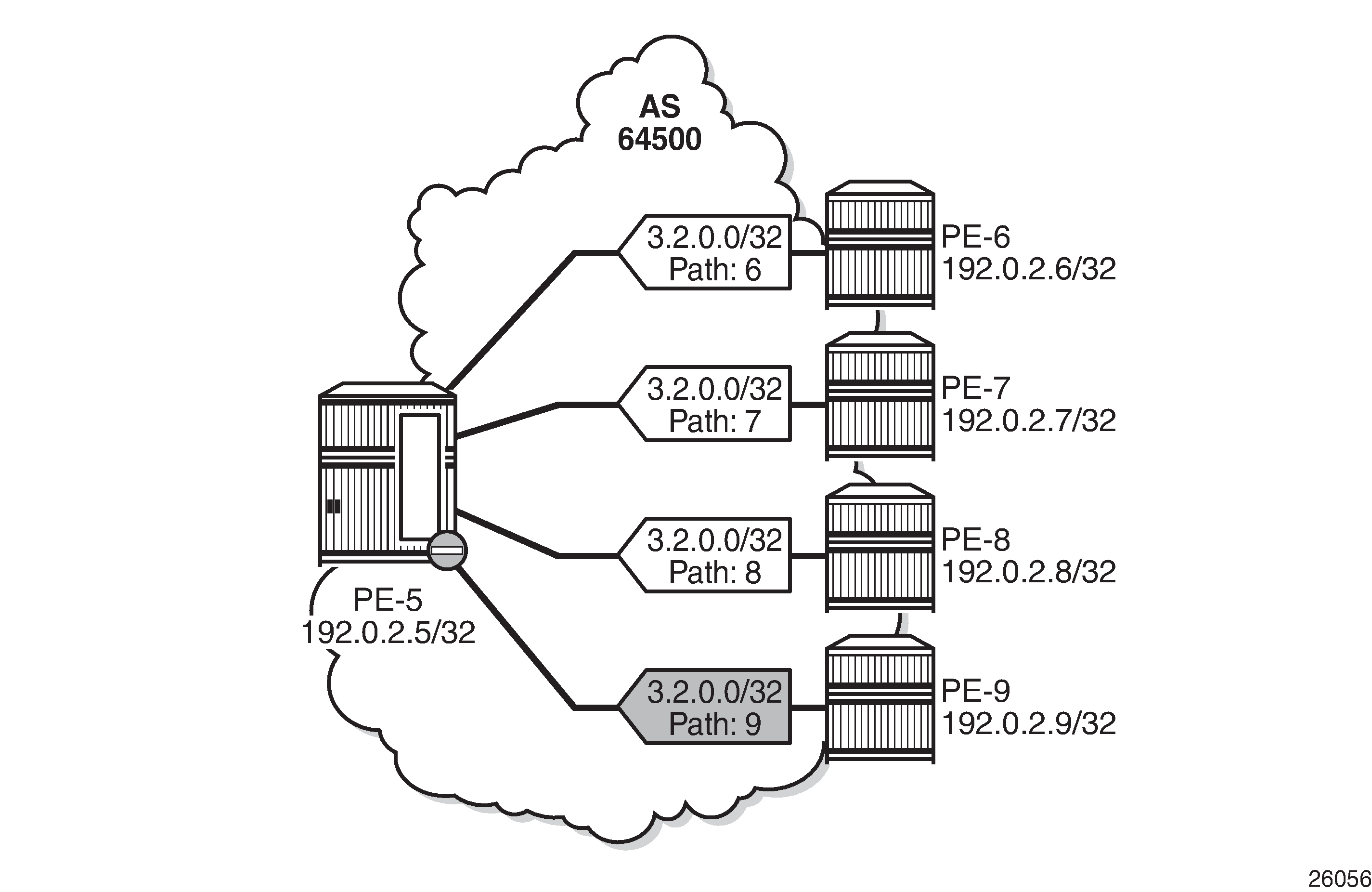
Three IBGP paths are used for prefix 3.2.0.0/32, as follows:
--{ + running }--[  ]--
A:admin@PE-5# show / network-instance default protocols bgp routes ipv4 prefix 3.2.0.0/32
-----------------------------------------------------------------------------------------
Show report for the BGP routes to network "3.2.0.0/32" network-instance  "default"
-----------------------------------------------------------------------------------------
Network: 3.2.0.0/32
Received Paths: 4
  Path 1: <Best,Valid,Used,>
    Route source    : neighbor 192.0.2.6
    Route Preference: MED is -, LocalPref is 100
    BGP next-hop    : 192.0.2.6
    Path            :  i [6]
    Communities     : None
  Path 2: <Best,Valid,Used,>
    Route source    : neighbor 192.0.2.7
    Route Preference: MED is -, LocalPref is 100
    BGP next-hop    : 192.0.2.7
    Path            :  i [7]
    Communities     : None
  Path 3: <Best,Valid,Used,>
    Route source    : neighbor 192.0.2.8
    Route Preference: MED is -, LocalPref is 100
    BGP next-hop    : 192.0.2.8
    Path            :  i [8]
    Communities     : None
  Path 4: <Best,Valid,>
    Route source    : neighbor 192.0.2.9
    Route Preference: MED is -, LocalPref is 100
    BGP next-hop    : 192.0.2.9
    Path            :  i [9]
    Communities     : None
Path 3 was advertised to:
[  ]
-----------------------------------------------------------------------------------------
BGP multipath restricted to the same neighbor AS
BGP multipath can be configured with the restriction that the neighbor AS must be the same for all the used paths. When all routes have a different neighbor AS, only one path is used. This can be shown for prefix 3.4.0.0/32 that is advertised by the IBGP neighbors. The BGP multipath configuration on PE-5 is as follows:
# on PE-5:
enter candidate
    network-instance default {
        protocols {
            bgp {
                afi-safi ipv4-unicast {
                    multipath {
                        allow-multiple-as false    # only one neighbor AS allowed
                        ebgp {
                            maximum-paths 2
                        }
                        ibgp {
                            maximum-paths 3
                        }
                    }
                }
BGP multipath configured with restriction to the same neighbor AS shows that with the restriction to the same neighbor AS, only one path is used because all BGP routes have a different neighbor AS.
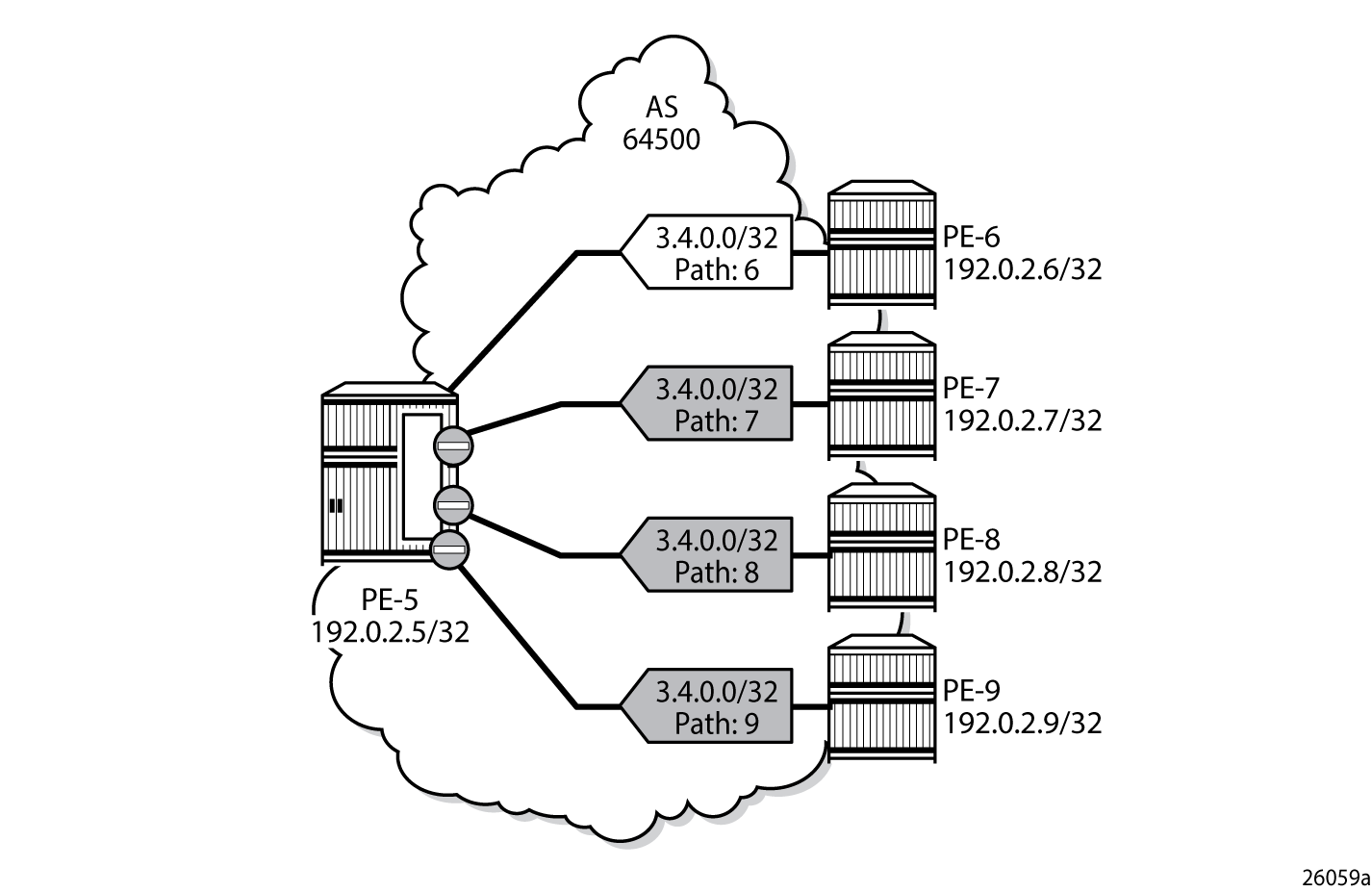
Only one BGP path is used, because all the other routes have a different neighbor AS, as follows:
--{ + running }--[  ]--
A:admin@PE-5# show / network-instance default protocols bgp routes ipv4 prefix 3.4.0.0/32
-------------------------------------------------------------------------------------------
Show report for the BGP routes to network "3.4.0.0/32" network-instance  "default"
-------------------------------------------------------------------------------------------
Network: 3.4.0.0/32
Received Paths: 4
  Path 1: <Best,Valid,Used,>
    Route source    : neighbor 192.0.2.6
    Route Preference: MED is -, LocalPref is 100
    BGP next-hop    : 192.0.2.6
    Path            :  i [6]
    Communities     : None
  Path 2: <Best,Valid,>
    Route source    : neighbor 192.0.2.7
    Route Preference: MED is -, LocalPref is 100
    BGP next-hop    : 192.0.2.7
    Path            :  i [7]
    Communities     : None
  Path 3: <Best,Valid,>
    Route source    : neighbor 192.0.2.8
    Route Preference: MED is -, LocalPref is 100
    BGP next-hop    : 192.0.2.8
    Path            :  i [8]
    Communities     : None
  Path 4: <Best,Valid,>
    Route source    : neighbor 192.0.2.9
    Route Preference: MED is -, LocalPref is 100
    BGP next-hop    : 192.0.2.9
    Path            :  i [9]
    Communities     : None
Path 1 was advertised to:
[  ]
-------------------------------------------------------------------------------------------
When the EBGP peers export the prefix 3.4.0.0/32 with a different AS path of equal length and the same neighbor AS, three of the BGP paths can be used. BGP multipath restricted to the same neighbor AS: AS paths with same length shows that the IBGP neighbors advertise prefix 3.4.0.0/32 with AS paths containing two ASNs with the neighbor AS equal to 4.
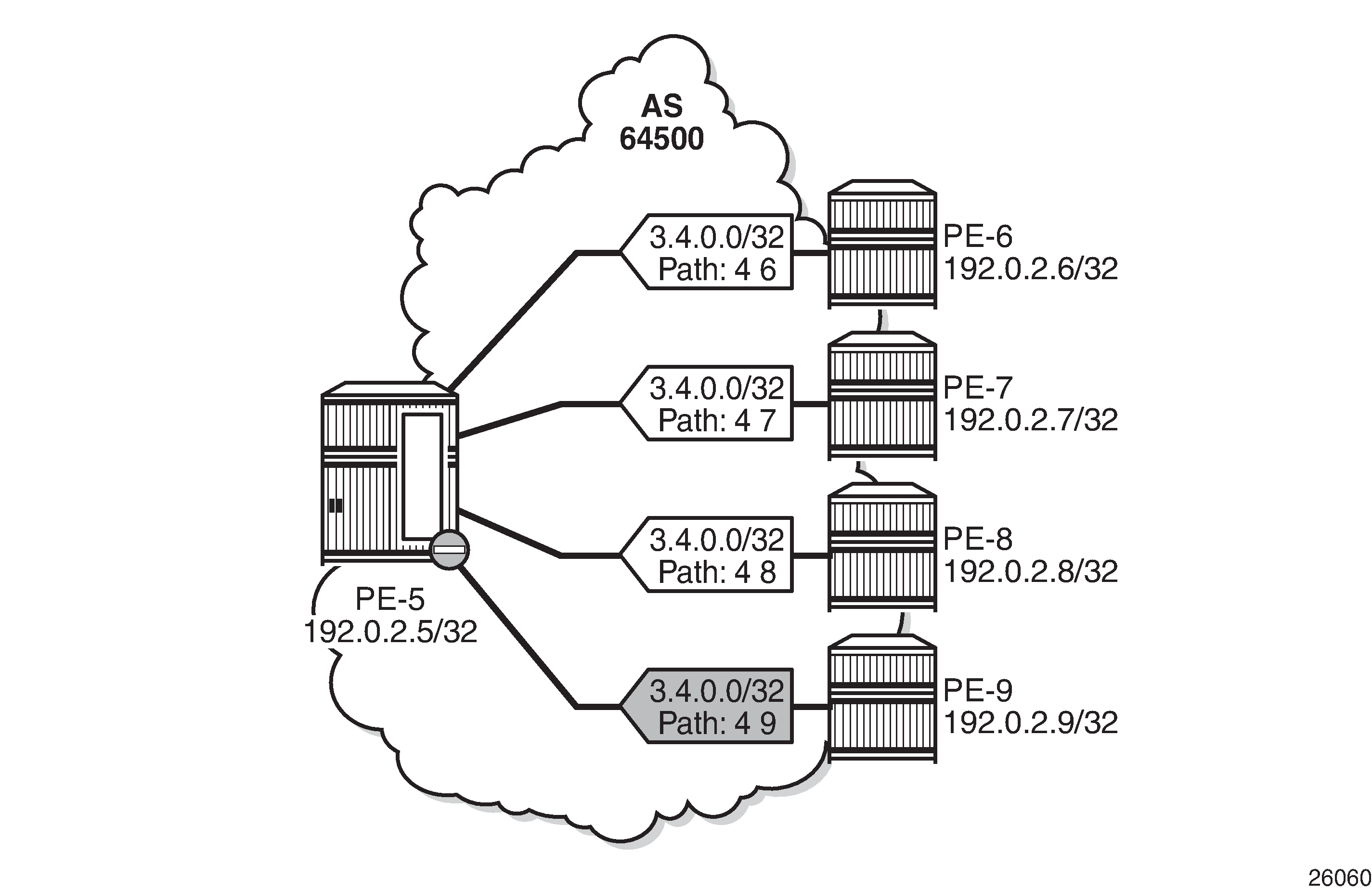
Three of the IBGP paths for prefix 3.4.0.0/32 are used, as follows:
--{ + running }--[  ]--
A:admin@PE-5# show / network-instance default protocols bgp routes ipv4 prefix 3.4.0.0/32
-----------------------------------------------------------------------------------------
Show report for the BGP routes to network "3.4.0.0/32" network-instance  "default"
-----------------------------------------------------------------------------------------
Network: 3.4.0.0/32
Received Paths: 4
  Path 1: <Best,Valid,Used,>
    Route source    : neighbor 192.0.2.6
    Route Preference: MED is -, LocalPref is 100
    BGP next-hop    : 192.0.2.6
    Path            :  i [4, 6]
    Communities     : None
  Path 2: <Best,Valid,Used,>
    Route source    : neighbor 192.0.2.7
    Route Preference: MED is -, LocalPref is 100
    BGP next-hop    : 192.0.2.7
    Path            :  i [4, 7]
    Communities     : None
  Path 3: <Best,Valid,Used,>
    Route source    : neighbor 192.0.2.8
    Route Preference: MED is -, LocalPref is 100
    BGP next-hop    : 192.0.2.8
    Path            :  i [4, 8]
    Communities     : None
  Path 4: <Best,Valid,>    # not used because the maximum number of IBGP paths is 3
    Route source    : neighbor 192.0.2.9
    Route Preference: MED is -, LocalPref is 100
    BGP next-hop    : 192.0.2.9
    Path            :  i [4, 9]
    Communities     : None
Path 3 was advertised to:
[  ]
-----------------------------------------------------------------------------------------
The restriction that the neighbor AS must be the same does not overrule the BGP selection criterion that the shorter AS path is preferred. When the AS path is longer for the route advertised by neighbor 192.0.2.7, only the BGP paths with the shorter AS path are used, as shown in BGP multipath restricted to the same neighbor AS: AS paths of different lengths.
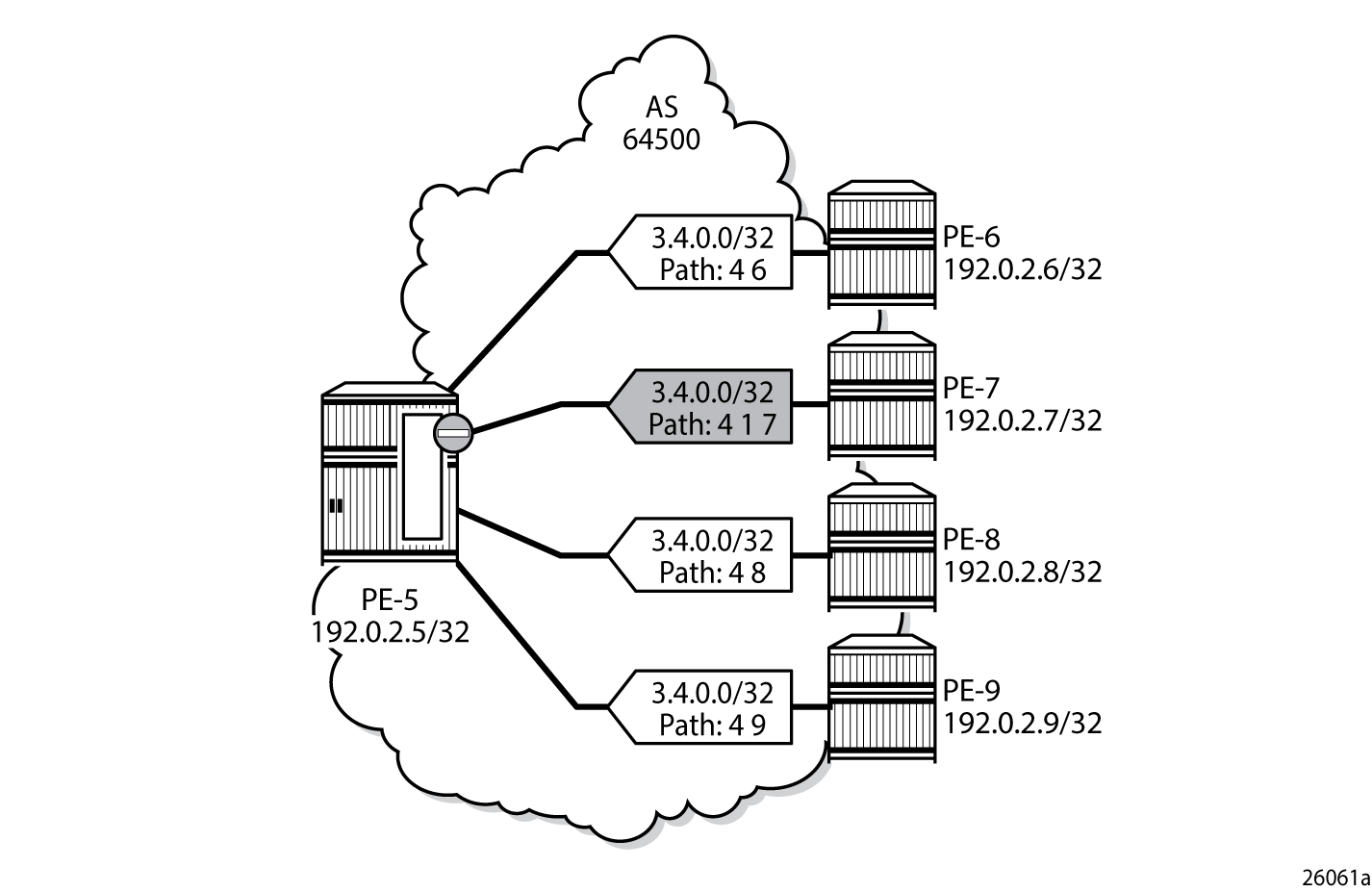
All BGP routes advertised by the IBGP neighbors have the same neighbor AS, but the AS path is longer for neighbor 192.0.2.7. The route advertised by this neighbor is not selected as best path and is not added to the route table. Only the three BGP routes with the shorter AS path are used, as follows:
--{ + running }--[  ]--
A:admin@PE-5# show / network-instance default protocols bgp routes ipv4 prefix 3.4.0.0/32
-----------------------------------------------------------------------------------------
Show report for the BGP routes to network "3.4.0.0/32" network-instance  "default"
-----------------------------------------------------------------------------------------
Network: 3.4.0.0/32
Received Paths: 4
  Path 1: <Best,Valid,Used,>
    Route source    : neighbor 192.0.2.6
    Route Preference: MED is -, LocalPref is 100
    BGP next-hop    : 192.0.2.6
    Path            :  i [4, 6]
    Communities     : None
  Path 2: <Valid,>
    Route source    : neighbor 192.0.2.7
    Route Preference: MED is -, LocalPref is 100
    BGP next-hop    : 192.0.2.7
    Path            :  i [4, 1, 7]    # not best because the AS path is longer
    Communities     : None
  Path 3: <Best,Valid,Used,>
    Route source    : neighbor 192.0.2.8
    Route Preference: MED is -, LocalPref is 100
    BGP next-hop    : 192.0.2.8
    Path            :  i [4, 8]
    Communities     : None
  Path 4: <Best,Valid,Used,>
    Route source    : neighbor 192.0.2.9
    Route Preference: MED is -, LocalPref is 100
    BGP next-hop    : 192.0.2.9
    Path            :  i [4, 9]
    Communities     : None
Path 4 was advertised to:
[  ]
-----------------------------------------------------------------------------------------
When PE-8 advertises the prefix with an AS path of two ASNs, with neighbor AS 3 instead of 4, there is no match anymore for the neighbor AS and only two BGP routes are used, as shown in BGP multipath restricted to the same neighbor AS: AS paths of different lengths or different neighbor AS.
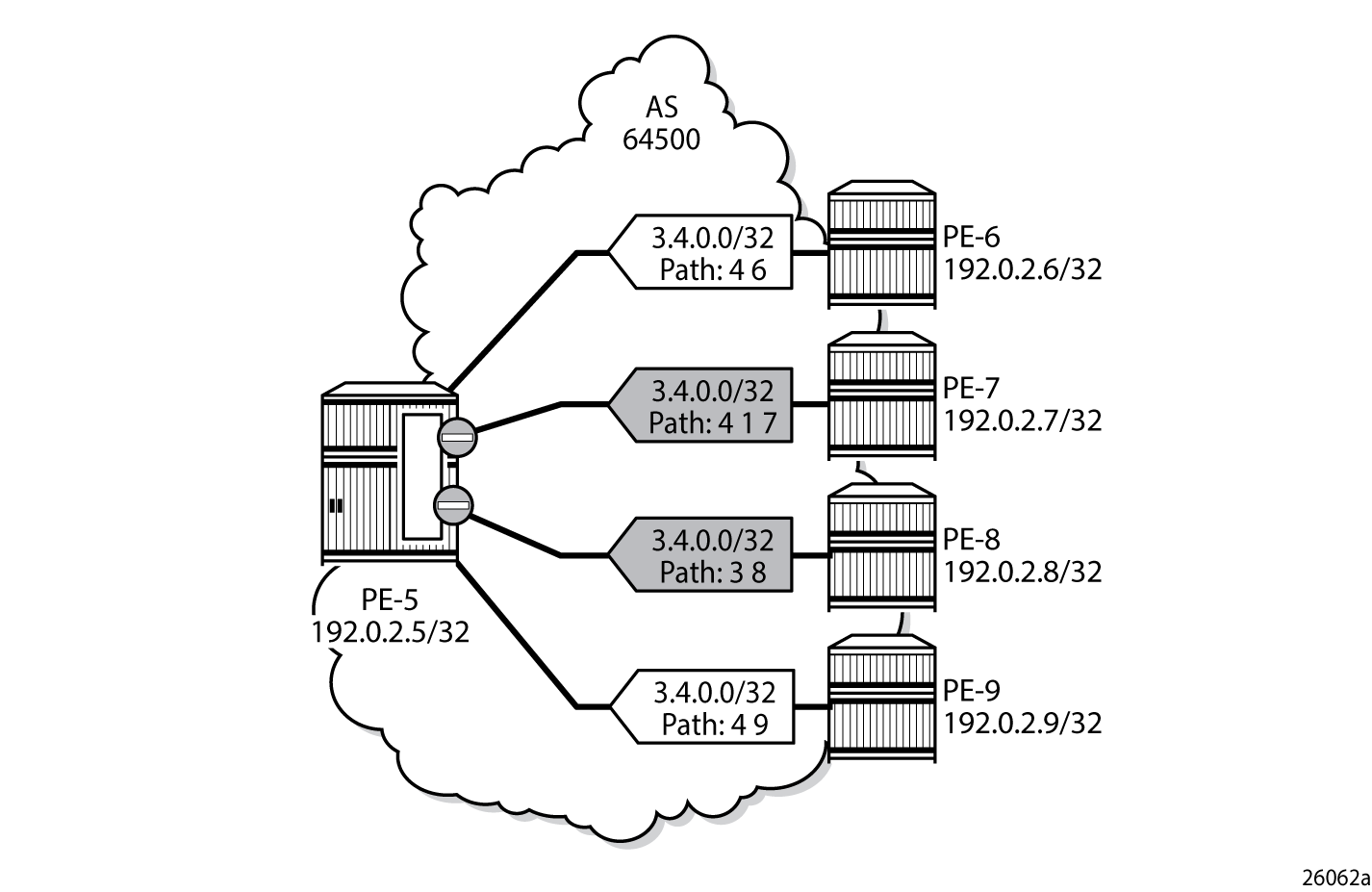
Two of the received BGP routes are used, as follows:
--{ + running }--[  ]--
A:admin@PE-5# show / network-instance default protocols bgp routes ipv4 prefix 3.4.0.0/32
------------------------------------------------------------------------------------------
Show report for the BGP routes to network "3.4.0.0/32" network-instance  "default"
------------------------------------------------------------------------------------------
Network: 3.4.0.0/32
Received Paths: 4
  Path 1: <Best,Valid,Used,>
    Route source    : neighbor 192.0.2.6
    Route Preference: MED is -, LocalPref is 100
    BGP next-hop    : 192.0.2.6
    Path            :  i [4, 6]
    Communities     : None
  Path 2: <Valid,>
    Route source    : neighbor 192.0.2.7
    Route Preference: MED is -, LocalPref is 100
    BGP next-hop    : 192.0.2.7
    Path            :  i [4, 1, 7]    # not best because the AS path is longer
    Communities     : None
  Path 3: <Best,Valid,>
    Route source    : neighbor 192.0.2.8
    Route Preference: MED is -, LocalPref is 100
    BGP next-hop    : 192.0.2.8
    Path            :  i [3, 8]    # not used because the AS neighbor is different
    Communities     : None
  Path 4: <Best,Valid,Used,>
    Route source    : neighbor 192.0.2.9
    Route Preference: MED is -, LocalPref is 100
    BGP next-hop    : 192.0.2.9
    Path            :  i [4, 9]
    Communities     : None
Path 4 was advertised to:
[  ]
------------------------------------------------------------------------------------------
BGP multipath per address family
On PE-6, PE-7, PE-8, and PE-9, the address families IPv4, label-IPv4, and label-IPv6 are configured in the context of IBGP neighbor 192.0.2.5. Prefix 3.7.0.0/32 is exported as IPv4 route, whereas prefix 3.8.0.0/32 is exported as label-IPv4 route, and prefix 2001:db8::3:8:0:0/32 as label-IPv6 route.
On PE-5, the address families IPv4, label-IPv4, and label-IPv6 are configured in the context of the grp-IBGP group, each with a different maximum-paths setting: maximum two IPv4 paths, maximum three label-IPv4 paths, and maximum four label-IPv6 paths:
# on PE-5:
enter candidate
    network-instance default {
        protocols {
            bgp {
                bgp-label {
                    labeled-unicast {
                        dynamic-label-block dlb-bgp-lu
                    }
                }
                afi-safi ipv4-unicast {
                    admin-state enable
                    multipath {
                        ebgp {
                            maximum-paths 2
                        }
                        ibgp {
                            maximum-paths 2
                        }

                    }
                }
                afi-safi ipv4-labeled-unicast {
                    admin-state enable
                    multipath {
                        ibgp {
                            maximum-paths 3
                        }
                    }
                    ipv4-labeled-unicast {
                        next-hop-resolution {
                            ipv4-next-hops {
                                tunnel-resolution {
                                    allowed-tunnel-types [
                                        ldp
                                    ]
                                }
                            }
                        }
                    }
                }
                afi-safi ipv6-labeled-unicast {
                    admin-state enable
                    multipath {
                        ibgp {
                            maximum-paths 4
                        }
                    }
                    ipv6-labeled-unicast {
                        next-hop-resolution {
                            ipv4-next-hops {
                                tunnel-resolution {
                                    allowed-tunnel-types [
                                        ldp
                                    ]
                                }
                            }
                        }
                    }
                }
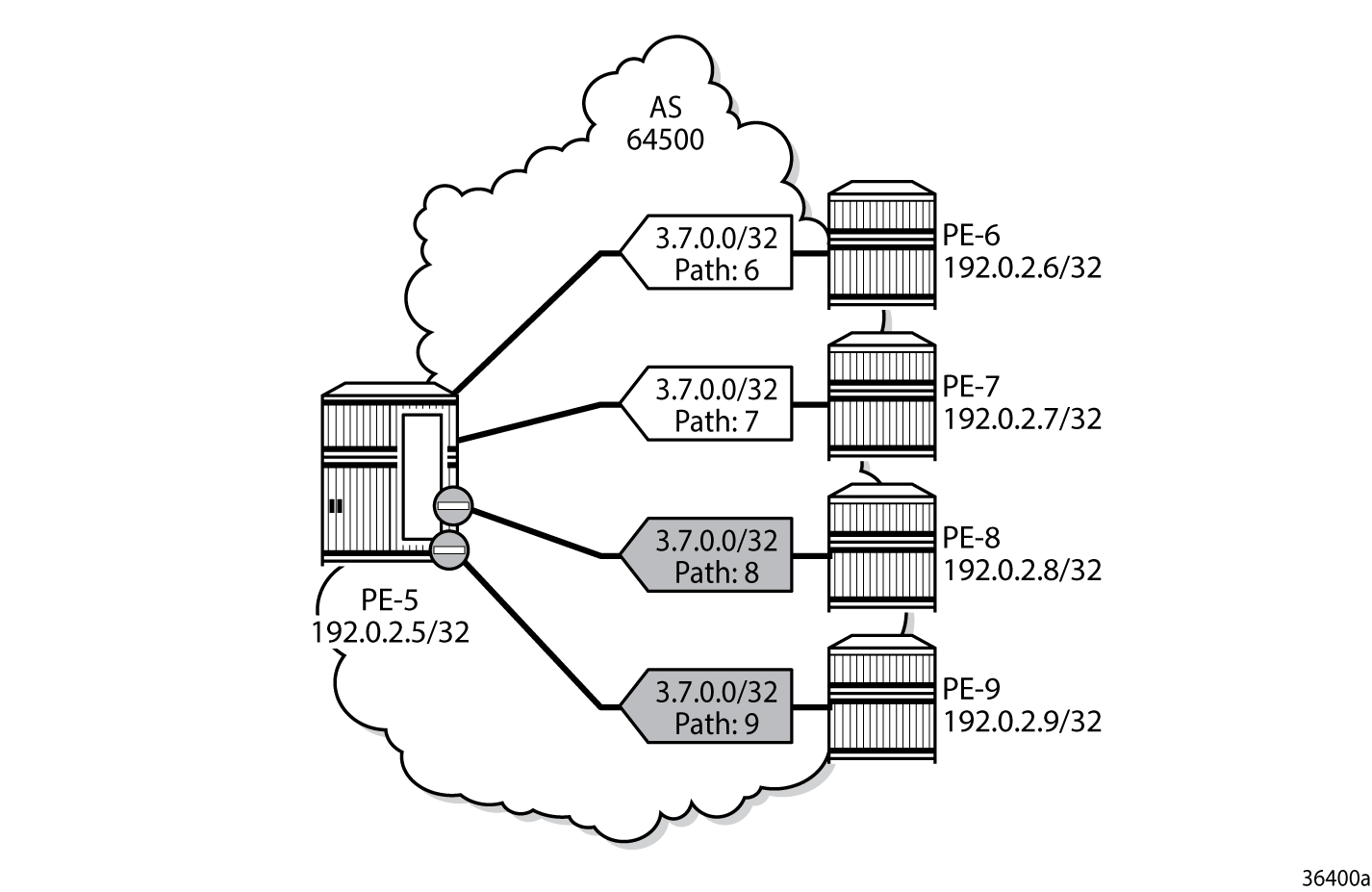
In this example, only IBGP routes are received. Two of the four received IPv4 routes for prefix 3.7.0.0/32 are used:
--{ + running }--[  ]--
A:admin@PE-5# show / network-instance default protocols bgp routes ipv4 prefix 3.7.0.0/32
-----------------------------------------------------------------------------------------
Show report for the BGP routes to network "3.7.0.0/32" network-instance  "default"
-----------------------------------------------------------------------------------------
Received Paths: 4
  Path 1: <Best,Valid,Used,>
    Route source    : neighbor 192.0.2.6
    Route Preference: MED is -, LocalPref is 100
    BGP next-hop    : 192.0.2.6
    Path            :  i [6]
    Communities     : None
  Path 2: <Best,Valid,Used,>
    Route source    : neighbor 192.0.2.7
    Route Preference: MED is -, LocalPref is 100
    BGP next-hop    : 192.0.2.7
    Path            :  i [7]
    Communities     : None
  Path 3: <Best,Valid,>
    Route source    : neighbor 192.0.2.8
    Route Preference: MED is -, LocalPref is 100
    BGP next-hop    : 192.0.2.8
    Path            :  i [8]
    Communities     : None
  Path 4: <Best,Valid,>
    Route source    : neighbor 192.0.2.9
    Route Preference: MED is -, LocalPref is 100
    BGP next-hop    : 192.0.2.9
    Path            :  i [9]
    Communities     : None
Path 2 was advertised to:
[  ]
-----------------------------------------------------------------------------------------
The last two IPv4 routes from PE-8 and PE-9 are not used because the maximum number of IPv4 IBGP paths (2) is exceeded.
BGP multipath for the IPv4 address family shows that two of the four received IPv4 routes are used.
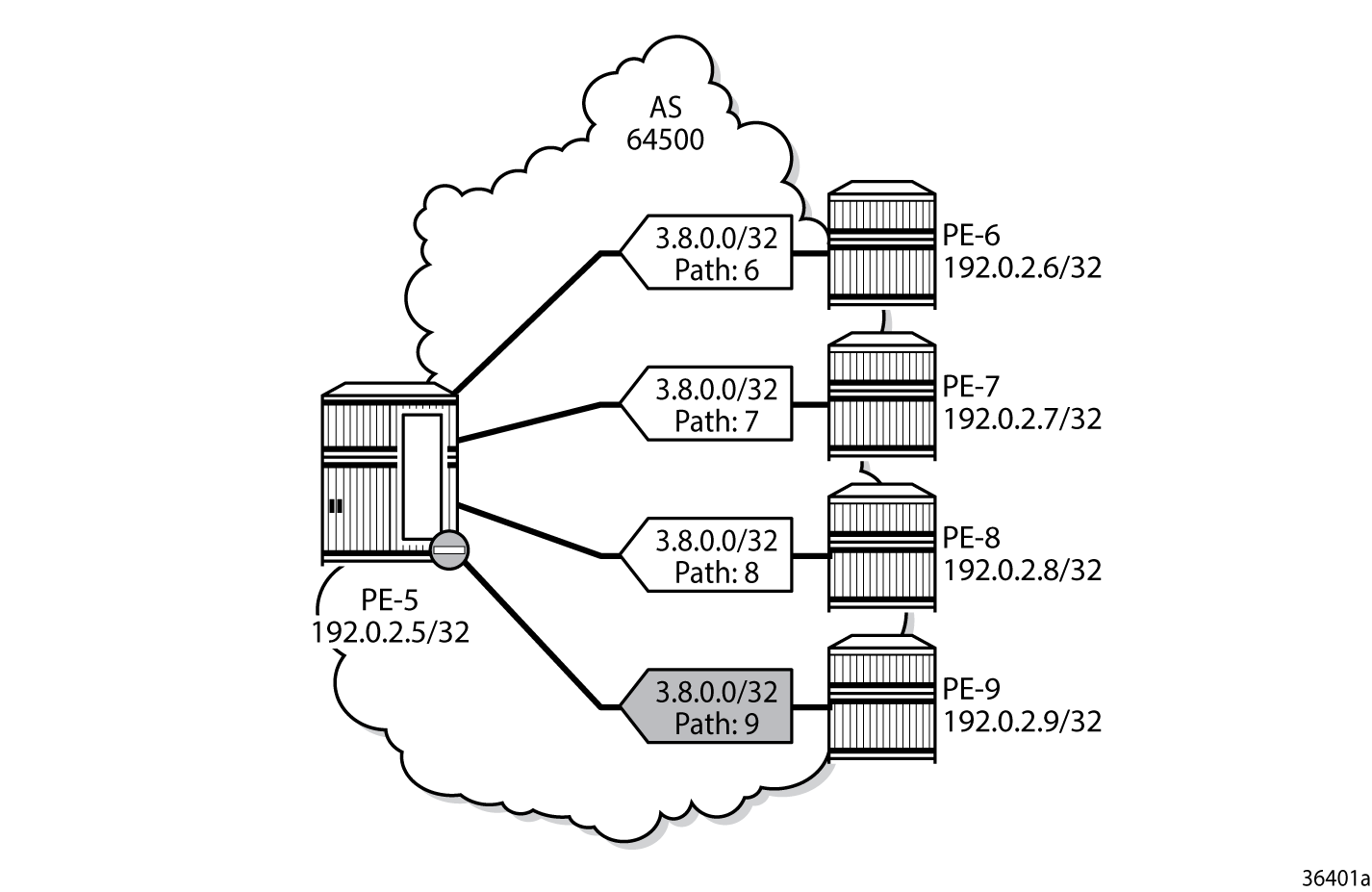
Three of the four received label-IPv4 routes for prefix 3.8.0.0/32 are used:
--{ + running }--[  ]--
A:admin@PE-5# show / network-instance default protocols bgp routes ipv4-labeled-unicast prefix 3.8.0.0/32
---------------------------------------------------------------------------------------------------------
Show report for the BGP routes to network "3.8.0.0/32" network-instance  "default"
---------------------------------------------------------------------------------------------------------
Received Paths: 4
  Path 1: <Best,Valid,Used,>
    Route source    : neighbor 192.0.2.6
    Route Preference: MED is -, LocalPref is 100
    BGP next-hop    : 192.0.2.6
    Path            :  i [6]
    Communities     : None
  Path 2: <Best,Valid,Used,>
    Route source    : neighbor 192.0.2.7
    Route Preference: MED is -, LocalPref is 100
    BGP next-hop    : 192.0.2.7
    Path            :  i [7]
    Communities     : None
  Path 3: <Best,Valid,Used,>
    Route source    : neighbor 192.0.2.8
    Route Preference: MED is -, LocalPref is 100
    BGP next-hop    : 192.0.2.8
    Path            :  i [8]
    Communities     : None
  Path 4: <Best,Valid,>
    Route source    : neighbor 192.0.2.9
    Route Preference: MED is -, LocalPref is 100
    BGP next-hop    : 192.0.2.9
    Path            :  i [9]
    Communities     : None
Path 3 was advertised to:
[  ]
--------------------------------------------------------------------------------------------------------
The last label-IPv4 route from PE-9 is not used because the maximum number of label-IPv4 paths (3) is exceeded.
BGP multipath for the label-IPv4 address family shows that three of the received label-IPv4 routes are used.
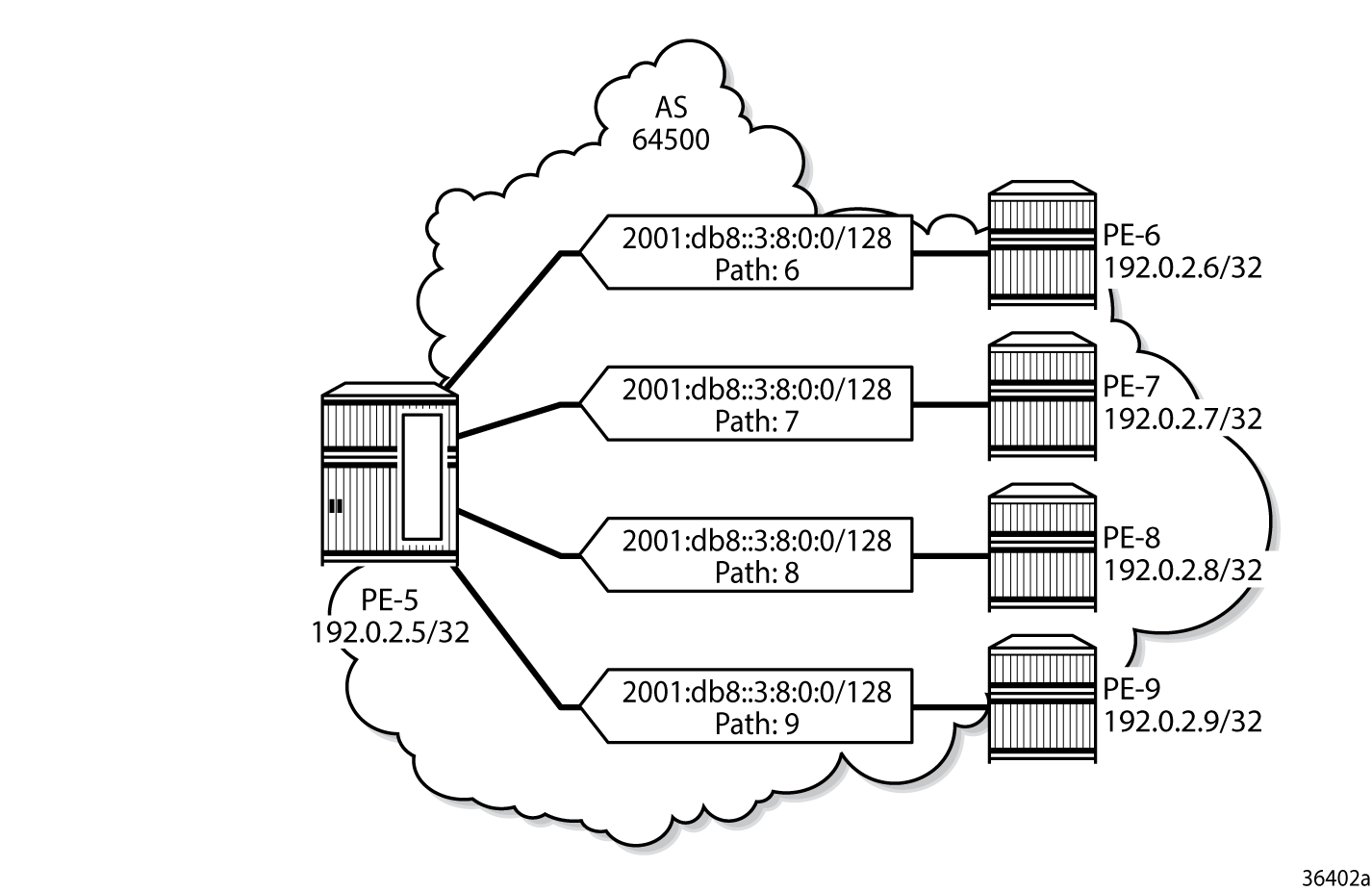
All four received label-IPv6 routes for prefix 2001:db8::3:8:0:0/128 are used:
--{ + running }--[  ]--
A:admin@PE-5# show / network-instance default protocols bgp routes ipv6-labeled-unicast prefix 2001:db8::3:8:0:0/128
--------------------------------------------------------------------------------------------------------------------
Show report for the BGP routes to network "2001:db8::3:8:0:0/128" network-instance  "default"
--------------------------------------------------------------------------------------------------------------------
Network: 2001:db8::3:8:0:0/128
Received Paths: 4
  Path 1: <Best,Valid,Used,>
    Route source    : neighbor 192.0.2.6
    Route Preference: MED is -, LocalPref is 100
    BGP next-hop    : ::ffff:192.0.2.6
    Path            :  i [6]
    Communities     : None
  Path 2: <Best,Valid,Used,>
    Route source    : neighbor 192.0.2.7
    Route Preference: MED is -, LocalPref is 100
    BGP next-hop    : ::ffff:192.0.2.7
    Path            :  i [7]
    Communities     : None
  Path 3: <Best,Valid,Used,>
    Route source    : neighbor 192.0.2.8
    Route Preference: MED is -, LocalPref is 100
    BGP next-hop    : ::ffff:192.0.2.8
    Path            :  i [8]
    Communities     : None
  Path 4: <Best,Valid,Used,>
    Route source    : neighbor 192.0.2.9
    Route Preference: MED is -, LocalPref is 100
    BGP next-hop    : ::ffff:192.0.2.9
    Path            :  i [9]
    Communities     : None
Path 4 was advertised to:
[  ]
-------------------------------------------------------------------------------------------------------------------
BGP multipath for the label-IPv6 address family shows that all four received label-IPv6 routes are used.
Conclusion
BGP multipath allows the IP routing table to have multiple BGP paths to the same destination. Different path limits can be applied for EBGP and IBGP paths and per address family. Restrictions can be imposed related to AS path, for example, only one neighbor AS is allowed.