
Service components
The following figure shows the logical entities used by a service model in SR OS to construct a service.
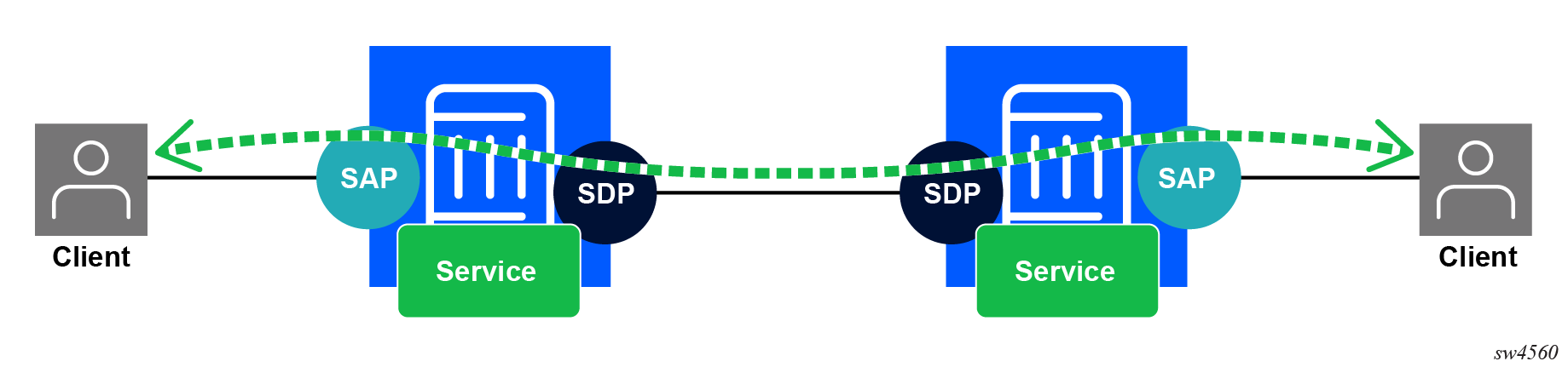
In the preceding figure:
-
The Service Access Point (SAP) identifies the customer-facing interface with null, dot1, or qinq encapsulation.
-
The Service Distribution Point (SDP) is the unidirectional transport tunnel that connects services between two routers. SDPs can use GRE, LDP, RSVP-TE, or segment routing tunnels. SDP is independent of service or type of service. Multiple services, whether of the same or different type, can share the same SDP. In such cases, traffic for each service is separated using a unique
vc-id, which is defined when the SDP is attached to a service.
For services that use BGP for transport signalling (such as VPRN, EVPN, VPLS), the SDP
configuration can be replaced with the auto-bind feature. This allows
the router to select from a variety of tunnel types.
SAP
A SAP is a client-facing interface and is the ingress point of the packets that will be carried over a service to the remote destination.
To configure a port as a SAP, set the Ethernet mode of the port to either
access or hybrid. If necessary, set the required
Ethernet encapsulation and MTU.
hybrid mode, minimum encapsulation
is dot1q./configure port 1/1/c10/1 admin-state enable
/configure port 1/1/c10/1 ethernet mode access
/configure port 1/1/c10/1 ethernet encap-type dot1q
/configure port 1/1/c10/1 ethernet mtu 5000SAPs are configured within a service configuration context.
/configure service epipe "Epipe-VLAN100" sap 1/1/c10/1:100SDP
An SDP is a unidirectional transport tunnel used to carry one or more services. SDP is identified by a numerical ID.
Before configuring an SDP, configure the transport protocol that the SDP will use: GRE, LDP, RSVP-TE, SR, SR-TE.
The following example creates an SDP on PE1 to PE3 that will use LDP.
/configure service sdp 510 admin-state enable
/configure service sdp 510 delivery-type mpls
/configure service sdp 510 ldp true
/configure service sdp 510 far-end ip-address 10.10.10.3
The association of the service with the SDP is configured under the service context. The SDP ID is used along with a unique vc-id, which is used to identify the service on the remote end. An MPLS label, generated for each unique vc-id, is used as the service label in MPLS encapsulation.
/configure service epipe "Epipe-VLAN100" spoke-sdp 510:100