
P2MP LSP control-plane behavior
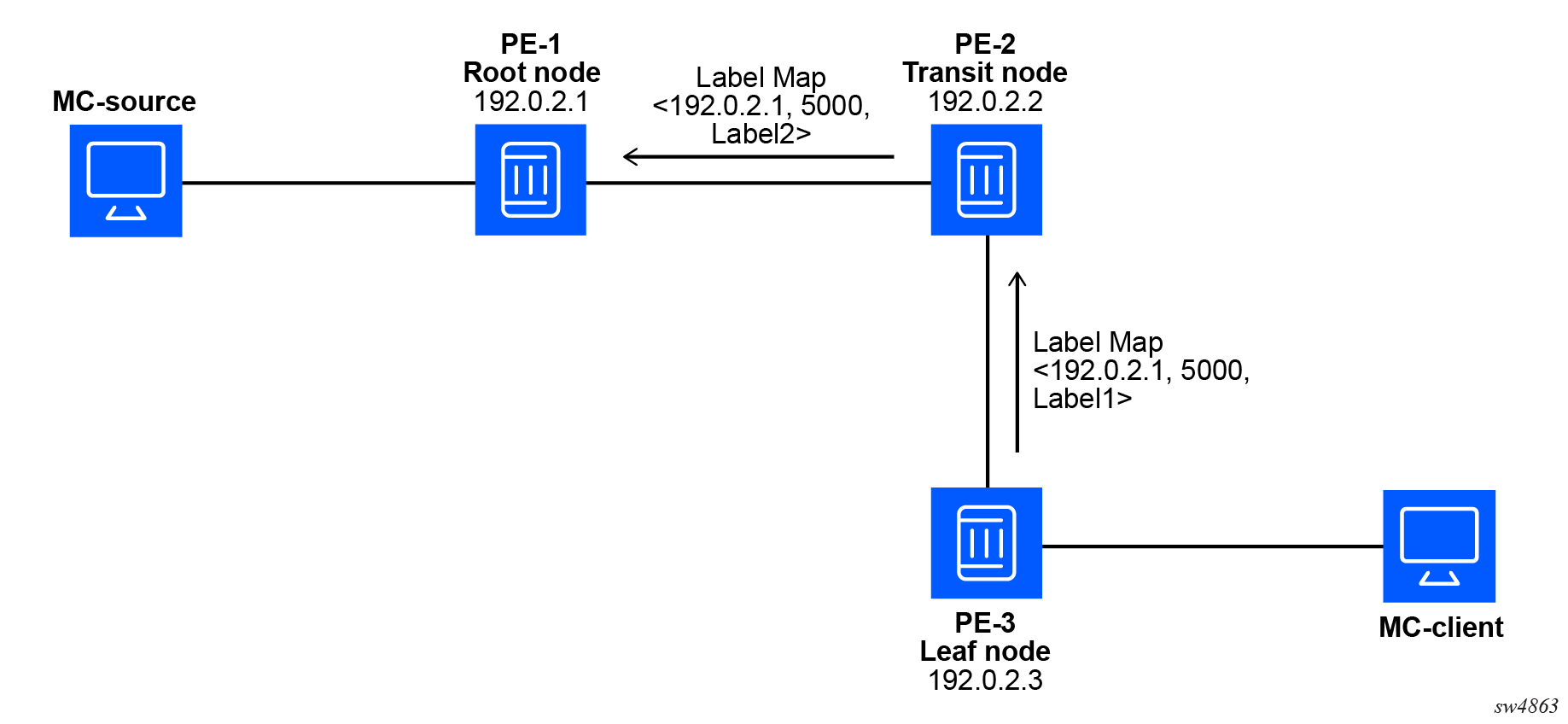
The control plane establishes an mLDP P2MP LSP as follows:
-
The leaf node initiates a tree setup by sending an LDP label map message to its upstream hop toward the root node of the tree.
-
Each transit node receives the LDP label map message and sends another LDP label map message to its upstream hop toward the root node of the tree. Each label can be different.
-
The root node receives the LDP label map message.
The label map message contains the root node address, an opaque value, and a label. In the following example, the root node address is 192.0.2.1 and the opaque value is 5000.
After the LDP label map messages are sent in the control plane, the nodes program pop, swap, or push entries for the corresponding labels in the data plane.
-
The leaf node programs a pop entry for the label it sent upstream.
-
The transit node programs a swap entry for the label it sent upstream with the next-hop address and the label it received from the downstream node.
-
The root node programs a push entry and a next-hop address for the label it received from the downstream node.
If multiple Equal Cost Multi-Path (ECMP) paths exist between two adjacent nodes, the upstream node of the multicast receiver must program all the entries in the forwarding plane. Only one entry must be active based on the ECMP hashing algorithm.
SR Linux does not support ECMP to downstream nodes on root, LSR, or Bud routers. It selects the first operational link or interface as the next hop.